Author: David E. Consigli

David Consigli, Jr. is a Certified Public Accountant and Partner at Ferraro, Amodio and Zarecki, CPAs. David has an Accreditation in Business Valuation and is a Certified Divorce Financial Analyst. David practices a philosophy built around providing clients with outstanding creative and personalized quality services. David's experience and expertise help him provide clients with the tools and resources they need to understand the valuation of closely-held businesses, especially when it comes to divorce. His strengths in communicating the results of his valuation conclusion to clients are qualities that make him a leader in the industry.

The Value of Your Biggest Asset

Most assets that private business owners accumulate come from one source, their business. Owners can accumulate real property such as a primary home, a beach house or a ski house. They acquire furniture, cars, boats, or a jet ski.  These assets are purchased either through salary or distributions earned from the business.  The business is the source of revenue to fund all the expenses of the business owner.

The owners spend countless hours in their business. They plan, budget, forecast. They do all the necessary things to operate it efficiently and effectively.  Time is spent on personal finances, planning for college and for retirement. Meetings are set up with the financial advisor, reviews assets and plans for the future.  The house is appraised, the retirement plans counted, debt calculated, and net equity is arrived at. But, one thing is missing, the value of the biggest asset, the business. How can one plan for the future without knowing the value of the biggest asset?  The business owner can ask themselves if any of these events will happen in the future.

  • Retirement
    • Sale of the business
    • Passing it on to a key employee
    • Passing it on to a child
  • Death or disability
  • Buyout of a shareholder
  • Divorce

If the answer is yes, then a business valuation needs to be performed. 

Some business owners feel the cost of a valuation is too expensive. Having a business valuation performed does not cost as much as one might think.  For example, let’s say the cost of a valuation is $15,000. If the value of the business is $1,500,000, the cost of the valuation is only 1% of the total value.  The chances any estimate of value is within $15,000 of the right value are slim. This means the best estimated guess needs to be within 1% of the right valuation.  Costs are pennies on the dollar. I performed a business valuation for a business which had a value of $10 million dollars. Total fees were $25,000. That means the fee were .25% of the total value. Chances of using an incorrect valuation number (guess) for planning are high and risky. 

Failure of not having a business valuation performed for your exit strategy can:

  • Fail to provide for loved ones, by lack of adequate insurance.
  • Cause scrutiny by the Internal Revenue Service, resulting in an audit.
  • Under value the business during a sale.
  • Over value gifts by not using discounts in the estate planning process.
  • Result in expensive litigation with shareholders or shareholder’s heirs.

Appraisals of privately owned businesses are a complicated process. The purpose of the valuation, the valuation date, standard of value, the ownership interest, and numerous other factors all affect how a business is valued.  To not have the valuation done by a professional or not done at all is irresponsible. 

Every owner leaves their business. The question the owner needs to ask is; do you want to plan for the exit or do you want to roll the dice and gamble with the biggest asset in your portfolio?




Ten Shortcuts to Increase the Value of Your Business

In the dynamic landscape of business, enhancing the value of your company is a strategic imperative. From financial credibility to strategic management, there are key shortcuts that can elevate the perceived worth of your business. In this guide, we delve into ten actionable strategies that not only bolster your company’s financial standing but also position it favorably in the eyes of potential buyers. These shortcuts, when implemented wisely, can make a significant difference in maximizing the value of your business.

  1. Have your financial statements audited or reviewed

    This can cost some money, but it gives your company creditability. A good accounting firm with a good reputation is worth its weight in gold. There are numerous alternatives to “Big 4” accounting firms. #AAFCPAs


  2. Have your CPA firm prepare a management letter

    If you have your financial statements audited a management letter will come with the audit. It will identify weaknesses you have in the accounting procedures and controls. You can then tackle these and correct them or at the very least identify them in the sale process. This exhibits knowledge to the potential buyer.


  3. Clean up the Balance Sheet

    Potential buyers want clean financial statements. The fewer adjustments that are made to the financials, the more creditability it becomes. Remove old assets no longer in service, write off bad accounts receivable, re-class loans to shareholders to equity, and absolutely remove any receivables owed from shareholders, either by repayment or compensation.

  4. Manage the Income Statement

    Reduce discretionary expenses. Reduce meals & entertainment, and auto expense, adjust officer’s salary to fair market value. Every dollar you save in an expense could increase the value of the business by $4 to $5. It is much more creditable to do now instead of having to do it through a normalized adjustment when it becomes time to sell.


  5. Develop a social media presence

    The world we live in is constant update, consistent feedback, what’s happening right now. Those of us on the older end may not like this but it is reality. Are you on Linkedin, Facebook, Twitter, Google+?  Part of the social media presence is recognizing posts by your customers. If this isn’t for you, then find someone in your organization to help out.


  6. Review Your Most Trusted Advisors

    Sometimes companies outgrow their trusted advisors. The attorney who is jack of all law trades may no longer be a fit. The sole proprietor or small accounting may longer be able to provide the tax and business consulting services your growing business needs.


  7. Know Who Your Competition

     Most businesses know who their competition is but not many document it. Write it down, list what strengths your company has over its competition, what are your weaknesses compared to your competition. Consider doing a S.W.O.T. analysis.


  8. Prepare Budgets

    Keep the budget versus actual comparison and make them accessible. The ability of a business owner to budget, compare to actuals and identify the variances and reason behind those variances. This exhibits your knowledge of business and attention to the details.


  9. Add Outside Directors

     See if you can find reputable, experienced business owners, consultants, attorneys, accountants, that have experience in your industry. They could help immensely with advice. In same token, start to remove family members who are not involved in daily business operations off the board of directors.


  10. Track Analytics to Your Industry

    There are statistics that you can track and see how your company stacks up within your industry. This is important as you look to sell your company and justify why your company will get a higher multiple than the average in the industry. If you do not stack up to your peers, then you know the areas of financial weakness (and unrealistic expectations).

As we navigate the terrain of business value optimization, the ten shortcuts outlined above serve as invaluable tools for entrepreneurs and business owners. From fortifying financial statements to embracing the digital age through social media presence, each shortcut plays a pivotal role in shaping a company’s worth. 

By adhering to these strategies, business owners not only enhance their credibility but also position their companies as robust entities ready for strategic growth and potential acquisitions. As you embark on the journey of increasing your business value, remember that these shortcuts are not mere quick fixes but rather thoughtful, strategic approaches to fortify the foundation of your business and propel it toward greater success.

Reasons to consider an Employer Stock Ownership Plan

Succession planning is always a challenge for the private business owner. Finding a buyer for business is not only difficult but also time consuming. Some owners do not want to transition their business to their current employees but they may not have the financial means to consummate a sale.

The consideration of creating an Employee Stock Ownership Plan (ESOP) may be the solution. Some of the benefits are:

Tax Benefits

  • Employees participating in an ESOP are not taxed on stock allocated to their accounts until they receive distributions, which is usually when they retire or leave the company.
  • The employer can under certain circumstances deduct contributions to the ESOP, including both interest and principal on loans the ESOP uses to buy the company stock. The company can also donate their shares of stock to the ESOP and get a deduction.
  • C Corporations can get a deduction for dividends paid to an ESOP used to repay loans, passed through to the participants or reinvested in company stock.
  • The owner of the C Corporation can defer taxation of the sale of the stock to the ESOP by complying with Internal Revenue Code Section 142 requirements.
  • S Corporations ESOPs do not pay taxes on their portion of the corporation’s income. The distributions paid to the ESOP can be used to pay down loans, fund benefits, or pay for administration expenses.

Benefits to the Employees who participate

  • Once an ESOP is established employees have an additional benefit that is not taxed until they receive distributions, which can then roll over into an Individual Retirement Account (IRA).
  • ESOP shares allow employees to have an invested interest in the financial well-being of the company on the same level as the original owners.
  • ESOPs can be a valuable asset to employees retirement planning.
  • ESOP contributions can be used to match employee 401(k) contributions, even under safe harbor matching formula. This creates greater participation in the company’s 401(k) plan making antidiscrimination testing requirements easier to comply with.

Benefits to the Employers

  • ESOPs can borrow money on employer credit to acquire the company stock. This alleviates cash funding challenges for the employees if they were to buy the company on their own.
  • Borrowed funds can be used to repurchase shares with pre-tax dollars.
  • Borrowed funds can be used to purchase new capital equipment needs, refinance other debt, to purchase other companies and other business purposes.
  • Employers benefit from ESOPs in the increase in morale and productivity of the ESOP owned employees. Employees are more productive when they have a vested interest in the financial welfare of the business.

Employee Stock Ownership Plans (ESOPs) present a strategic and tax-efficient solution for private business owners navigating the challenges of succession planning. With benefits spanning tax advantages for both employees and employers, enhanced retirement planning, and a positive impact on company dynamics, ESOPs emerge as a compelling strategy. By fostering a sense of ownership and aligning the interests of owners and employees, ESOPs offer a symbiotic approach to succession, ensuring a smoother transition for businesses and their stakeholders


Top Five Valuation Mistakes in Your Buy/Sell Agreement

A Buy/Sell Agreement, also called a business pre-nuptial agreement, or a business will, is a legal document that is used as the mechanism governs business owners when one of them leaves the business. The reality is that every business owner is going to leave. The reasons could be the owner quits, dies, becomes disabled, retires, or is fired.  Buy/sell agreements can also alleviate problems creating with shareholders going through a divorce. Here are five mistakes often overlooked in Buy/Sell Agreements. 

  1. Valuations are not updated-The most common changes that happen in a privately owned business are that the value of the business changes over time. If the business valuation is not updated then if a triggering event occurs what happens?
  2. The Buy/Sell Agreement calls for multiple Appraisers-This can be a very costly proposition. The agreement will state that an appraiser for each side values the business and if they are not within a certain percentage, then a third appraiser is hired. This can be very costly paying for up to three appraisers.  A better approach is to have one appraiser who updates the appraisal on a consistent basis (every two years or so).
  3. Using a Formula Method to Value-using a formula method can certainly cut costs on a formal appraisal and may seem easy, but in most situations the value of your business interest is your biggest asset. Wouldn’t you want to know with a high level of certainty that you are getting and/or paying the accurate amount for the business?
  4. Not properly funding life insurance proceeds-In the worst case scenario the shareholder passes away and his heirs are paid with life insurance proceeds. The Internal Revenue Service assesses a value much higher than what is reported on the estate tax return. The heirs now have a tax bill and in addition, don’t receive full value for the business.
  5. The wrong standard of value is used-the standard of value is predicated on state law. This is where the appraiser and the attorney work together to make sure that discounts are not taken where they are not appropriate. 

Buy/Sell Agreements are meant to provide the means to transfer ownership interests in a business during the triggering event. The correct valuation is a critical component of those means. Hiring a qualified thought leader in the industry will help alleviate the stress that comes this important succession planning tool.

Asset Division in Divorce

There are many factors that go into the asset division among couples during the divorce process. The process is predicated by state law. To determine the division of property, the courts look to the factors enumerated in DRL 236B.  In New York and Massachusetts asset division is defined as equitable distribution.

Equitable distribution means the courts will attempt to make sure the assets are divided in a fair way under the circumstances. This does not always mean a 50/50 split. Even in a 50/50 split you need to know the tax consequences of each asset being divided. This means you also need to know the tax basis of your assets. Otherwise, a 50/50 split may not mean a true 50/50 split.

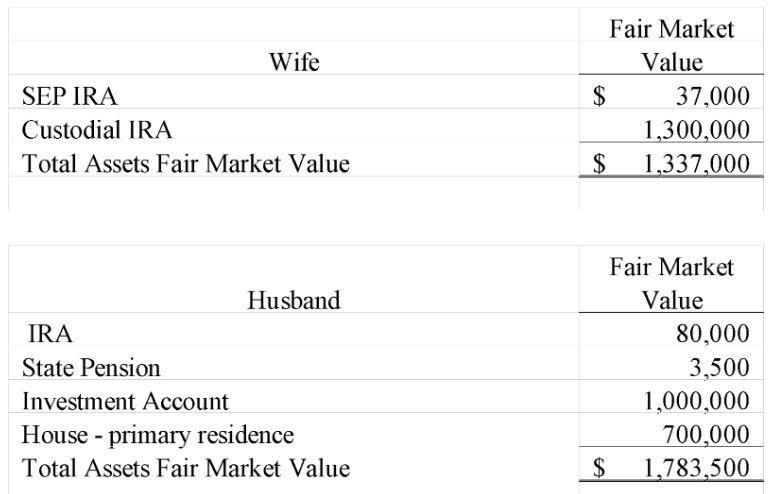
For example, assuming husband and wife have the following assets each will keep post-divorce.

If the assets were to be split equally, the husband would have assets more than $446, 500 and would owe the wife an equalization payment of $223,250 shown as follows:

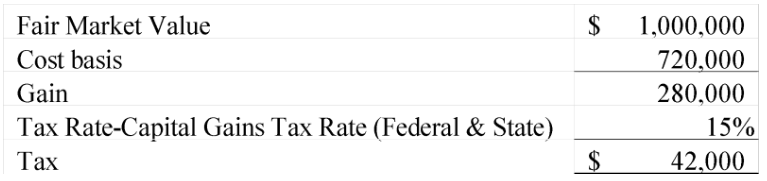
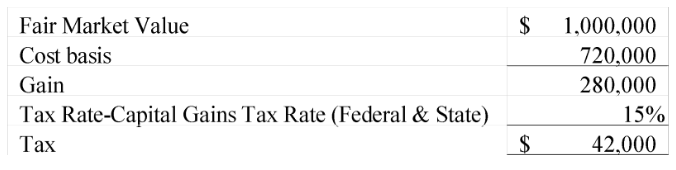
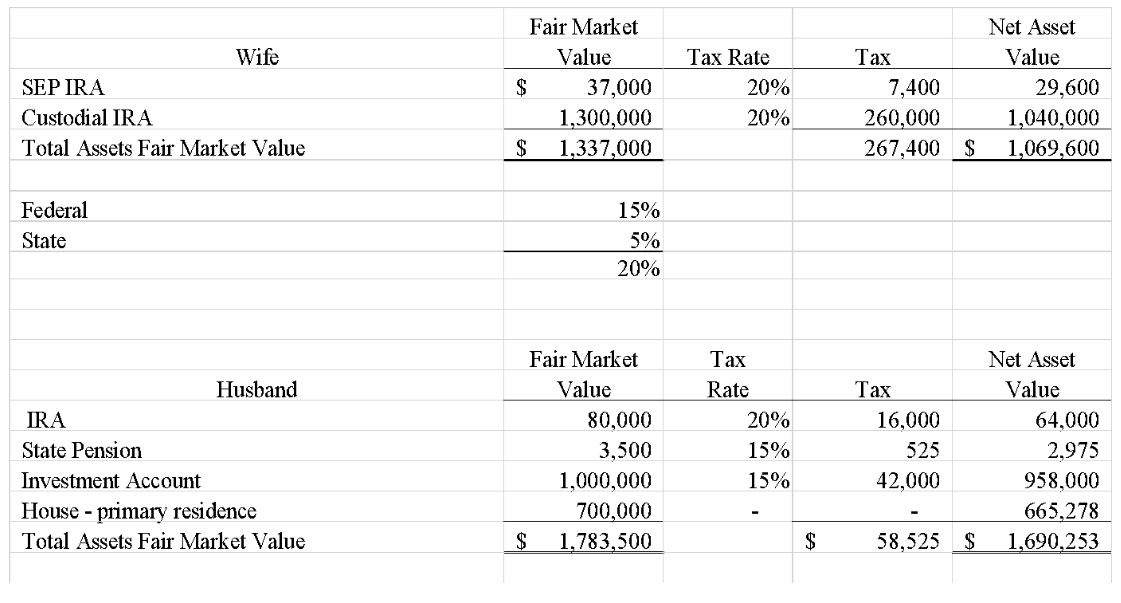
However, certain assets may have different tax consequences that need to be taken into consideration. The house is the couple’s primary residence, and they qualify for a capital gains tax exclusion since they have lived there for two of the past five years. The investment account has a tax basis of $720,000 resulting in a capital gains tax of $42,000 at capital gains tax rate of 15% (both federal and state). 

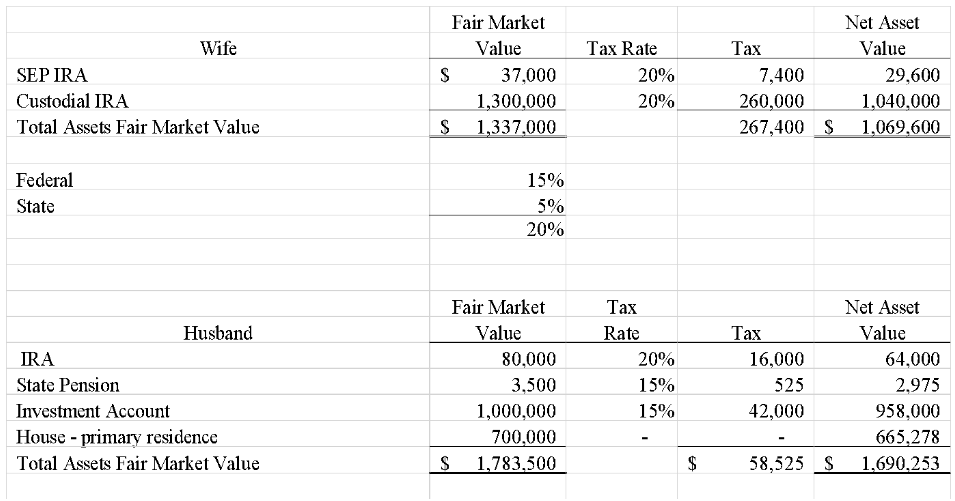
All the other assets would be taxed at their individual tax rates based on income of 20%, except for the state pension, which is not taxable at the state level.

Now when we look at the net asset value after consideration of tax consequences the asset division looks much different.

Taking tax considerations into account becomes essential to equalize the asset division, leading to adjustments in the equalization payment.  By factoring in the tax implications of each asset, the process ensures a more balanced and fair division of assets between the parties involved.

It is important to understand that asset divisions are done on an after-tax basis and therefore not all assets are created equal unless the tax consequences are taken into consideration. A 50/50 split may not be a true 50/50 split without the help of a Certified Public Accountant trained in divorce financial planning.

Valuation Court is now in Session: New and Historical Cases Impacting Valuations Today

Host: Saumya Tayi, CPA/ABV, Director, Alix Partners, LLP

Guest(s): Natalya Abdrasilova, CPA/ABV, MAFF, CVA, Director of Valuation & Litigation Services, BDM, PC and David Consigli, CPA/ABV, CDFA, Partner and Lead, FAZ CPAs Business Valuation Practice

In litigation, the decisions in court cases create precedence for future court cases. Keeping up to date on current court decisions and the background can help you prepare your valuation for court and support it in testimony.

Join Saumya, one of our newer hosts, as she speaks with Natalya Abdrasilova, and David Consigli and they delve into and discuss the valuation implications and technical valuation components of the cases.

Listen Now

For further exploration on this topic: If you’re using a podcast app that does not hyperlink to the resources, please visit https://fvssection.libsyn.com/fvs to access the show notes with direct links. 

This podcast episode is part of the extensive resource library available from the AICPA’s Forensic and Valuation Services Section, the premier provider of guidance, tools, and advocacy for professionals who specialize in providing forensics, valuation, litigation, and fraud services.  If you’re not already a member, visit us online and consider joining this active community of your FVS peers. You’ll get free CPE and access to rich technical content.

Don’t Miss an Episode

Follow us wherever you get your podcasts and leave us a review using this link or copy and paste this URL into your browser https://forms.office.com/r/4cjNd6m1TJ so we can continue bringing valuable and relevant content to you. Any other issues can be sent to podcast@aicpa-cima.com

Information on Credentials

Our FVS credential programs allow AICPA members to demonstrate competence and confidence in providing forensic and valuation services to their clients.

From Retention to Report Issuance and Everything In Between

Host: David Consigli, CPA/ABV, CDFA, FAZ CPAs

Guest(s): Nicole Lyons, CPA/CFF, CVA, Partner, WithumSmith+Brown, PC and Brian Schwartz, Attorney at Law, JD, Partner at Szaferman Lakind

Description: Lawyers and accountants need to work together in litigation support in a collaborative effort. Bringing in an attorney adds another layer to what happens in engagements in the litigation space. Today’s episode features both the attorney’s perspective and the forensic and/or valuation specialist, specific topics covered are:

  • Statement on Standards for Forensic Services No. 1 (SSFS No. 1) and how the expert needs to remind and assist the attorney
  • A road map for the new forensic and valuation expert start starting out in litigation support engagements
  • A good refresher for the experts
  • How and what happens behind the scenes.
Listen Now

The ABC’s of ADR’s


The end of a marriage is much more than just a legal event; it also encompasses financial and emotional changes that have consequences for the entire family. It doesn’t have to result in a costly “he said, she said battle” with complex legal issues not understood by the common folk. Finding an alternate method can set the stage for successful co-parenting relationships and mutually satisfactory agreements. Today, more than ever before, disputing parties are opting to settle their differences through alternative dispute resolution (“ADR”) proceedings. ADR is a compelling alternative to settling disputes without litigation. As the structure of ADR evolves, so does the role of the financial expert. It’s optimal for the seasoned professional to be involved from the onset of a dispute to shorten resolution time and cost.

The three most widely used ADR methods are:

Arbitration

The chosen arbitrator is generally someone both sides’ lawyers deem to be an expert. The arbitrator will listen to testimony given under oath and review all documents submitted. It’s often considered an informal trial as the arbitrator can issue binding decisions. These decisions are then made into a court order. The process can be flexible and suited to the party’s needs.

Collaborative Divorce

A scenario where financial experts, lawyers, mental health practitioners, and others come together to create a unified solution. The parties and their attorneys sign a participation agreement, setting a framework for the process and agreeing to settle without going to court. In the event the case goes to litigation, the attorneys must resign. The goal is to settle every issue, share relevant information, and negotiate together.

Mediation

Both sides hire a mutually agreed-upon neutral third party. This person cannot make decisions or give either side legal advice. Their role is to facilitate communications until a compromise is reached. They provide facts to help the parties gather all relevant information to make informed decisions and settle jointly. The mediator has no authority to exact a settlement.


Whichever method you use, it can be crucial to have a financial expert with you every step of the way. It’s their job to discern the numbers and present their findings in a clear, concise, and understandable manner. They can investigate any financial discrepancies between the parties. With a strong understanding of all the numbers, the marital assets, and balance sheets can be updated throughout the process. They can also provide tax advice and help avoid certain complications that may arise. This is even more important after the 2018 Tax Cuts and Jobs Act, which cuts individual income tax rates, doubles the standard deduction, and eliminates personal exemptions. It’s better to know an acceptable range of possible outcomes before going in. The right professional can also value the family business, provide income analysis, calculate child support and alimony payments, as well as trace assets.

We have a staff of experts with a variety of credentials in fields such as business valuation, accounting, and financial analysis. We’ve acted as both a defendant and plaintiff expert, as well as a neutral party. Let us alleviate one less concern.

Business Valuation in Divorce

The divorce process can be stressful and emotional, particularly when dealing with financial decisions involving a family-owned business. A family business can either hold significant value as the largest family asset or simply function as a source of income, providing the owner with a job.


When a business is part of a divorce context, the parties should consider the following:

Choose the Right Types of Valuation:

Calculation of Value

A calculation engagement involves fewer procedures than a valuation engagement, resulting in a calculated value that is usually less costly. According to SSVS No. 1, a calculation engagement occurs when the valuation analyst and the client agree on the valuation approaches, methods, and the extent of procedures. The calculated value, expressed as a single amount or a range, has limited scope and is not suitable for divorce contexts. Typically used in the preliminary stages of divorce valuation, it may help control costs and initiate negotiations. However, it should not be used in the litigation process except for negotiations. Calculations of value may have a specific amount or a range of values, with reporting mechanisms usually being a one-page letter report or an oral report.

Conclusion of Value

Certified Public Accountants must adhere to definitions outlined by the Statement on Standards for Valuation Services (“SSVS”) No. 1 issued by the American Institute of Certified Public Accountants (“AICPA”). SSVS No. 1, issued in June 2007 by AICPA, specifies that a valuation engagement, involving more procedures than a calculation engagement, results in a conclusion of value and is generally more expensive. The engagement occurs when the valuation analyst estimates the value of the subject interest, applying valuation approaches and methods deemed circumstantially appropriate. Conclusions of value have no scope limitation, and reporting options, such as oral reports, letter reports, summary reports, or detailed reports, can help contain the cost of the valuation engagement. In the context of divorce, lower levels of reporting may not meet the objective of communicating the valuation conclusion to the end user and/or reader. It is advisable to start at a lower level but be prepared to move up to the next reporting level if the litigation progresses.


Choose the Right Qualified Appraiser:

During the divorce process, ensure the retention of the right qualified appraiser(s). Many Certified Public Accountants (CPAs) have performed valuations on a part-time basis over the years, but given the consistent changes in the valuation field, finding an appraiser committed to the industry and holding credentials such as Accredited Senior Appraiser (ASA), Accredited in Business Valuation (ABV), Certified Valuation Analyst (CVA), or Certified Business Appraiser (CBA) is crucial.


Hire Only One Appraiser:

This is not the norm, but certainly not out of the ordinary either. There are two reasons why hiring one independent appraiser makes sense. The first reason is that valuation engagements performed by a qualified, respected appraiser can be costly. Good appraisers do not cut corners. They explore every avenue and every aspect considered in a conclusion of value engagement. This takes time and money, but the end result is a valuation that can stand up to any and all scrutiny. The cost of divorce is also expensive, and wherever money can be saved, it should be done. There are some appraisers who will perform the valuation on the cheap, but these are also the ones that are not as thorough. You get what you pay for. The second reason is independence.

The American Institute of Certified Public Accountants (AICPA) Code of Professional Conduct, Rule 102 – Integrity and Objectivity states:

“In the performance of any professional service, a member shall maintain objectivity and integrity, shall be free of conflicts of interest, and shall not knowingly misrepresent facts or subordinate his or her judgment to others.”

The AICPA Statement on Standards for Valuation Services No. 1 states:

“The principle of objectivity imposes the obligation to be impartial, intellectually honest, disinterested, and free from conflicts of interest. If necessary, where a potential conflict of interest may exist, a valuation analyst should make the disclosures and obtain consent as required under Interpretation No. 102-2.”

The hard part for valuation analysts is they are usually hired by one side or the other. It is challenging for most analysts to remain independent and not be advocates for their clients. Some of the best appraisers do not understand this. They will issue an opinion that is as high or as low as they can defend. This is not the way it is supposed to be. To solve that problem, only hire one. There will be no obligation, whether subliminal or not. The single appraiser now becomes a consultant explaining the appraisals and what part of the appraisal is subjective and where there could be ranges of value. This consultant role could not happen with an adversary on the other side.


Making the wrong choices and decisions in a divorce can be costly — and slow down the process. Couples need honest, efficient, and well thought out advice to keep the process moving and make them feel as comfortable as possible as they move onto the next phase of theirlives.

Navigating Non-Profit Finances with Strategic Valuation

Just like their for-profit counterparts, privately-owned companies aren’t the only ones benefiting from the wisdom of valuation experts. Non-profit organizations, too, can find tremendous value in the insights gained from an independent business appraisal. At FAZ Forensics, we stand ready to assist non-profits under various circumstances, ensuring they navigate financial decisions with clarity and confidence.


Conversion to For-Profit Status:

In the unique scenario of a non-profit contemplating a switch to for-profit status, a non-profit valuation becomes a crucial tool. Many states mandate this assessment before greenlighting the conversion, making it an essential step in the process.

Sale or Spin-off of Divisions/Profit Centers:

Within the non-profit landscape, certain divisions or businesses may no longer align with the mission or prove worth the associated costs. An independent valuation steps in, determining the right sales price and facilitating the market entry of the division for sale or spin-off.

Mergers of Non-Profits:

As the non-profit arena witnesses a growing trend of mergers between entities with similar missions, valuations become integral. Determining the fair value of each party involved aids in navigating these transactions smoothly.

Mergers with For-Profit Businesses:

In cases where a non-profit merges with a for-profit organization, reporting asset transfers at fair market value is a must for compliance with federal tax codes. Our valuation services ensure accuracy in this crucial reporting process.

Sale of Partial Ownership Interest:

For non-profits structured as partnerships or limited liability companies, selling a general partnership interest may have tax implications. An independent valuation becomes a safeguard, helping calculate fair market value and mitigating future tax liabilities.

Donations:

IRS regulations mandate that donations exceeding $5,000 in value be supported by an appraisal. Non-profits may receive donated stock from major shareholders selling their businesses. A thorough valuation process ensures proper recording of such gifts, reducing taxable portions of proceeds.

Foundations:

Certain foundations require annual valuations to determine the distribution of assets. A meticulously calculated valuation proves instrumental in understanding the total value of foundation assets, facilitating informed decision-making.

Offering sound valuation services to non-profit organizations isn’t just about meeting accounting and tax requirements. It’s about empowering them in critical financial decisions, whether it’s navigating mergers, facilitating asset transfers, or ensuring compliance. For non-profits seeking a secure financial path, FAZ Forensics is here to answer questions and provide our valuable insights.

Asset Division


There are many factors that go into the asset division among couples during the divorce process. The process is predicated by state law. In order to determine the division of property, the courts look to the factors enumerated in DRL 236B.  In New York and Massachusetts asset division is defined as equitable distribution.

Equitable distribution means the courts will attempt to make sure the assets are divided in a fair way under the circumstances. This does not always mean a 50/50 split. Even in a 50/50 split you need to know the tax consequences of each asset being divided. This means you also need to know the tax basis of your assets. Otherwise, a 50/50 split may not mean a true 50/50 split.

For example, assuming husband and wife have the following assets each will keep post-divorce.

If the assets were to be split equally, the husband would have assets more than $446, 500 and would owe the wife an equalization payment of $223,250 shown as follows:

However, certain assets may have different tax consequences that need to be taken into consideration. The house is the couple’s primary residence, and they qualify for a capital gains tax exclusion since they have lived there for two of the past five years. The investment account has a tax basis of $720,000 resulting in a capital gains tax of $42,000 at capital gains tax rate of 15% (both federal and state). 

All the other assets would be taxed at their individual tax rates based on income of 20%, with the exception of the state pension, which is not taxable at the state level.

Now when we look at the net asset value after consideration of tax consequences the asset division looks much different.

Taking tax considerations into account becomes essential to equalize the asset division, leading to adjustments in the equalization payment.  By factoring in the tax implications of each asset, the process ensures a more balanced and fair division of assets between the parties involved.

It is important to understand that asset divisions are done on an after-tax basis and therefore not all assets are created equal unless the tax consequences are taken into consideration. A 50/50 split may not be a true 50/50 split without the help of a Certified Public Accountant trained in divorce financial planning.

Marketability Discounts

Host: David Consigli, CPA/ABV, CDFA, FAZ CPAs

Guest(s): Brian McIntyre, CVA, Partner, Withum – Forensic and Valuation Services and Natalya Abdrasilova, CPA/ABV, MAFF, CVA, Director of Valuation & Litigation Services, BDM, PC

Description: In this episode we interview Brian McIntyre and Natalya Abdrasilova, presenters at the 2022 FVS Conference, and discuss the following:

  • Concepts surrounding marketability discounts are always evolving
  • The criticality of finding data to support your conclusions
  • Need to be flexible to different options for valuing marketability
  • There is no “one size fits all” for determining marketability discounts
  • Common errors Natalya and Brian have observed
Listen Now

For further exploration on this topic: If you’re using a podcast app that does not hyperlink to the resources, please visit https://fvssection.libsyn.com/fvs to access the show notes with direct links.

Resources available as part of FVS Section membership: BRG (Business Reference Guide) Online – Provides an overview of different markets to create a baseline to develop discounts. Available for purchase from AICPAconferences.com: AICPA-CIMA Forensic and Valuation Services Conference, session: Marketability Discount

This podcast episode is part of the extensive resource library available from the AICPA’s Forensic and Valuation Services Section, the premier provider of guidance, tools, and advocacy for professionals who specialize in providing forensics, valuation, litigation, and fraud services. Visit us online at www.aicpa.org/fvs, and if you’re not already a member, consider joining this active community of your FVS peers. You’ll get free CPE, and access to rich technical content.

Don’t Miss an Episode

Follow us wherever you get your podcasts and leave us a review using this link or copy and paste this URL into your browser https://forms.office.com/r/4cjNd6m1TJ so we can continue bringing valuable and relevant content to you. Any other issues can be sent to podcast@aicpa-cima.com.

Information on Credentials

Our FVS credential programs allow AICPA members to demonstrate competence and confidence in providing forensic and valuation services to their clients.

  • ABV Credential (Accredited in Business Valuation)
  • CFF Credential (Certified in Fraud and Forensics)
Read Our Reviews

FAZ Forensics is rated 4.95 out of 5.0 stars based on 21 review(s).

---

FAZ Forensics did a full review and evaluation of my business and I was very happy with the level of detail and expertise.

- Chris Schmidt

---

Christian has, along with his good nature and thoughtful regard, been exceedingly helpful with sorting out the complexities of our case. We could not be more pleased with our exchange. Thomas and Hema Easley

- Thomas Easley

---

Christian was patient and easy to understand. clear, concise and thorough. he spoke “plain” English and was respectful. he did not “rush” and he responded to every question i had, in a timely manner. no matter how “dumb” it may have seemed. for example, i received some paperwork by mail and i did not understand it. i emailed him about it and he cleared it up that day. thats great customer service!

- Joong Park

---

Really good, very knowledgeable and communicated with us every step of the way.

- Haartz Corporation/Tom Daigneault

---

FAZ has a great team doing terrific work for our clients.

- Jim Towne

---

Exceptional work produced.

- Matt Smith

---

Thanks!

- Arrow Bank

---

FAZ was very professional, knowledgeable and very fair priced. The work performed was prompt, accurate and reliable. I would absolutely hire them again if in need for additional accounting work.

- Arrow Financial Corporation

---

Excellent to work with. Professional and personable.

- Cambridge Central School District

---

Awesome team! They were a pleasure to work with. I would definitely recommend.

- Cambridge Central School District

---

FAZ was extremely thorough and professional in doing our business valuation. We are very pleased with the results

- Anne Choppy

---

Steve and GeNet were great at the valuation we needed. Very satisfied. Thanks,Vince and Anne

- Vincent M. Choppy

---

Perfect

- Zalazar anelardo

---

Gen'et and Paul were extremely responsive to our needs. They listened and responded to any concerns that we had. I would highly recommend them for any forensic engagement needs.

- Jennifer Mulligan

---

Thank-you for asking. Our experience was excellent. The people at FAZ showed a depth of knowledge and experience that was very helpful with the undertaking before us. Well done.

- Guy Tombs

---

The CPAs and staff at FAZ are truly amazing. They explain their process very well and always answered my questions right away. I highly recommend them for all your forensic accounting and evaluation services.

- Ashley Hart

---

Excellent and responsible.

- Peter Lee

---

Steve Ferraro did an excellent job and worked tirelessly as our expert forensic accountant witness. Based on Steve's hard work, the jury awarded every penny that Steve showed our client to be entitled to and completely rejected the conclusions of the opposing side's expert.

- Dave Paliotti

---

Great firm!

- John Harwick

---

The people at FAZ are amazing. They are true professionals. The staff is knowledgeable & kind. You feel like you matter. Anytime I have questions they take the time to go through everything in detail so I completely understand everything. I would definitely recommend FAZ.

- Dan Dagostino