Author: Stephen L. Ferraro

Stephen Ferraro, CPA is a Partner with Ferraro, Amodio & Zarecki CPAs (FAZ). FAZ is an experienced team of leading forensic CPAs, valuation experts, Certified Fraud Examiners (CFEs) and business advisors who seek to truly understand clients’ needs. Serving Albany, Boston, NYC, White Plains, Saratoga Springs and the surrounding areas, they leverage deep experience and a genuine, people-focused approach to provide best-in-class forensic accounting, business valuation and business advisory services. www.fazforensics.com

Seeing the Big Picture with Your Business Exit

Exit Planning

The success of exiting a business depends greatly upon the mental perspective and preparation of an owner during the exit process. Business owners tend to fixate their thoughts only on running and growing their business.  However, there is a tremendous amount of value in seeing the ‘big picture’ with your exit and thinking about the future and where you would like both the company, and yourself personally, to end up.  The owner who is able to see the larger picture and understands that stepping out of a business is an opportunity to move both themselves and their company toward a new stage of life, will be best prepared to execute a successful business transition.  This newsletter is written to help owners think through the ‘big picture’ and align their thinking and resources towards a successful exit.

The Transfer Timing Slots

One of the first ‘big picture’ concepts that owners should grasp is the idea of ‘timing slots’.  Much like a slot machine, you want to see if you can match up three (3) critical areas – (1) personal timing, (2) company preparedness, and (3) market timing.  A solid ‘big picture’ of an exit considers all three.

Let’s Begin with Market Timing

Markets run in cycles and timing is important.  If a business is performing well because there is a favorable economy, all things being equal, this can be an optimal time to consider an exit.  Valuation is high, employees are engaged, and – often times – buyers / investors have a high degree of interest and activity.

As the chart below indicates, the last three (3) decades have followed a similar market cycle and this decade is following suit.  
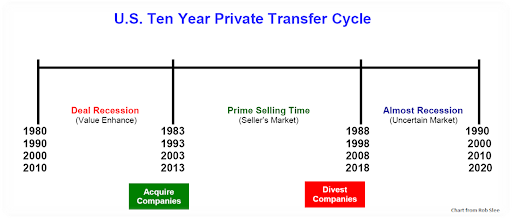
Chart-Exit Planning

Therefore, if you believe the information above, your ‘big picture’ in terms of market timing indicates that the next few years are ideal in terms of market timing.

Company Preparedness

The 2nd ‘big picture’ concept for an exit is Company preparedness.  In other words, your business needs to be [at least somewhat] transferrable to have a successful exit.

There are a large number of items that can lead to poor timing for an exit and lack of company preparedness.  For example, you may have recently had a departure of a key manager, or you may have lost a key customer and need time to replace that revenue.  Alternatively, your CFO or controller may not have your finances in order, or you may have a lawsuit pending that should really be resolved before moving ahead with a transfer of the business.

While timing can rarely ever be perfect, it is important to think through the current and forecasted profitability and valuation to see that your company’s preparedness is optimal for a successful transaction that will result in a valuation and deal structure that works for you personally.

Personal Timing

The final ‘big picture’ concept – and the third consideration in the timing slots of an exit – is personal readiness.  In fact, it probably makes sense to begin the ‘big picture’ thinking of an exit with personal planning.  The reason is that this can be the most complex and take the most amount of time to navigate.  Also, how an owner thinks about an exit is what is most likely to drive the exit process.  In other words, the market and company can be perfectly positioned for an exit, but if the owner does not want to leave, it is possible that an exit process will not begin.

A Vision for a Personal Future Without the Company

Prior to considering any of the various options for exiting your business, you must be able to recognize two key elements within yourself:

  •   Realization of where you are right now, and
  •   A clear vision of where you want to be after the exit.

As a successful business owner, you realize that you have created self-worth and profit for both the company and those around you, including your family members.  In building a company, you have built a personal identity, perhaps the only one which is recognized by some family, friends, and business associates. Many owners, without properly considering their new, post-exit identities will be unable to successfully pursue a business exit because of their continued attachment to the business.  In order to ensure a smooth transition, you want to be able to articulate both where you are in your business today and the personal challenges associated with getting you to where you want to be.

Developing Exit Skills

The key to achieving the vision – or the ‘big picture’ – for your exit is an understanding that the tools and skills which have enabled you to build your business will likely be of limited value in planning your exit from the business; you’ll need to learn new skills.  If you are using the same tools, skills, and thoughts that you used to run and grow your business, it is very difficult to move on to the next phase.  The primary reason why this is true is that the development of business value is not entirely consistent with the development of fulfilling personal needs and values. A ‘big picture’ look at your situation will have you begin to ask questions about ‘why’ it is important to design an exit plan that meets the needs that you have defined. 

Concluding Thoughts

Seeing the “big picture” in your exit involves taking the time to reflect on goals of the business, the timing of the market, but most importantly, your interests and objectives outside of the business.  Exploring your personal goals allows you to confidently move forward to the next phase of life, which may or may not include continued involvement with the company.  As in so many aspects of one’s life, perspective is key to ultimate success.  By viewing your exit as an opportunity to a begin a new lifestyle instead of as a loss of your business identity, you can begin developing a ‘big picture’ for your exit.

Two Distinct Valuation Standards and Why They Matter…

Business Valuation

We all use terms in our area of expertise that make people outside our fields scratch their heads.  When you start discussing business valuations with a valuation expert, two terms you often might hear are Fair Market Value and Fair Value. They sound like they could be interchangeable, but they are, in fact, very different. The Standard of Value chosen is fundamental to the valuation itself and can lead to different values, even if the interest being valued is exactly the same.  

Fair Market Value

The most commonly known and accepted standard of value is fair market value. It is defined by the Internal Revenue Service (IRS) in its Revenue Ruling 59-60 as, “the price at which the property would change hands between a willing buyer and a willing seller when the former is not under any compulsion to buy and the latter is not under any compulsion to sell, both parties having reasonable knowledge or relevant facts.”

Fair market value is the number that reflects what the business would be valued in a sale between a buyer and seller who both have full knowledge of the facts and are under no duress. Basically, absent synergistic or investment value, it’s the amount you would expect to receive if you put your business out for sale into the open market.

The key word in fair market value is “market”. Consider common stock traded on the New York Stock Exchange (NYSE). Investors buy and sell stock of large companies on the NYSE all the time without having any controlling interest. Apply that to a smaller business without shares being actively traded on an exchange. A valuation that uses fair market value as a foundation searches for the market equivalent for a closely held business share.

For business valuation purposes, fair market value is typically used in the following cases:

  • Inheritance, estate, and gift transfers of assets
  • IRS filings and other transfers governed by IRS rules
  • Auction or open market sales of business entities

Fair market value is primarily differentiated from fair value on the basis of application of two valuation discounts. Typically, fair market value considers these discounts:

  • Discount for Lack of Marketability: This discount considers the lack of ability to rapidly convert an ownership stake to cash.
  • Discount for Lack of Control: This discount accounts for a minority interest impacting the amount of control the seller has over the business. When a minority interest exists, there is often lack of control over matters like salaries, distributions, or entity sale.

Fair Value

Fair value is defined by the Financial Accounting Standards Board’s Generally Accepted Accounting Practices (GAAP) as “the price that would be received to sell an asset or paid to transfer a liability in an orderly transaction between market participants at the measurement date” . That sounds similar to the IRS definition for fair market value, but in terms of valuation, there are differences.

As opposed to fair market value, fair value is a legal concept rather than a value set by the market. Fair value tends to be defined by statute. These statutes vary from one jurisdiction to another. Typically, fair value does not take discounts for marketability or lack of control into consideration. It is often used when valuing businesses for these situations:

  • Partner and shareholder disputes
  • Business owners buy/sell agreements dealing with internal share transfers
  • Determining business value in marital dissolutions

Fair market value is typically the starting point for calculating fair value. Adjustments are then made in the interest of treating all parties fairly. In the case of minority shareholders who dissent from agreement to a merger or other transaction, the fair value standard prevents controlling shareholders from forcing minority shareholders to accept a lower price. By definition, the minority shareholders in such a transaction are not the “willing sellers” free from “compulsion to sell” envisioned by the fair market value standard; the fair value standard takes this into consideration to protect the interests of the minority shareholders.

Fair value is defined in many jurisdictions as the shareholder’s proportionate share of the fair market value of the business. Discounts for marketability or lack of control do not apply for obvious reasons: If the sale of the business has already been negotiated absent minority shareholders’ assent, the issue of marketability is moot, and dissenting minority shareholders are being bought out of their stake in the company. In addition, appreciation or depreciation in the business’ value arising from anticipation of the transaction are also commonly excluded in determining fair value.

Fair Value is also referred to as Equitable Value, which is the estimated price for the transfer of an asset or liability between identified knowledgeable and willing parties that reflects the respective interests of those parties. Equitable Value requires the assessment of the price that is fair between two specific, identified parties considering the respective advantages or disadvantages that each will gain from the transaction.

Need Help with a Business Valuation?

At FAZ CPAs, our valuation specialists are extremely experienced in all acceptable valuation methods. We bring many collective decades of expertise in forensic accounting, valuation, and litigation support to every project. 

Commercial Damages - Insurance and Finance

Selecting a Financial Expert: Commercial Damages

Whether working for the Plaintiff or the Defendant, selecting a forensic CPA and commercial damages expert is typically a very important decision all attorneys need to make in a complex commercial litigation matter. In most cases the jury, and even the trier of fact, will not be very well versed in the financial issues. Consequently, the damages expert needs to be a person who can explain complex accounting and financial concepts in a clear, concise and easy to understand manner. A capable expert will be able to explain how these concepts relate to the economic damage model and supporting calculations. As many attorneys recognize, finding a suitable expert can be a challenging process.

Several factors must be taken into consideration before selecting the right expert, particularly if the prospects for deposition and/or trial testimony are significant. Engaging an experienced and knowledgeable expert who has previously testified in a deposition and/or trial can be very valuable for the attorney and their client. The following are some specific factors that should be considered when selecting a commercial damages expert:

Relevant and Current Training: The expert should have formal forensic training specific to the calculation and presentation of commercial damage analyses in a litigation or similar contentious environment. Many organizations which grant supporting forensic credentials (discussed below) require that minimum continuing educational requirements be met to maintain their designations. A typical requirement is 120 hours over a three-year period…or. on average, 40 hours per year.

Related Forensic Experience: Attorneys should evaluate the commercial damage expert’s amount of relevant experience. Look for a damage expert who has worked on comparable cases. While lack of prior industry experience in most cases is not a deal breaker, it might be preferred in certain instances. 

Previous Testimony Experience: Attorneys should investigate previous cases to see the opinions and reports the damage expert has issued in the past for deposition or trial. Counsel should also find out whether an expert has been subject to Daubert challenges and/or has had their opinion excluded at trial. This is a critical part of the selection process.

Supporting Credentials: The damage expert’s credentials are an important part of the decision-making process. The attorney should look for a damage expert with relevant credentials governed by the American institute of Public Accountants (AICPA), the National Association of Certified Valuation Analysts (NACVA) and other relevant organizations.  Some of the more pertinent credentials are the following: Certified Public Accountant (CPA), Master Analyst in Financial Forensics (MAFF), Certified Business Appraiser (CBA). Chartered Financial Analyst (CFA), Accredited in Business Valuation (ABV), Certified in Financial Forensics (CFF) and Certified Valuation Analyst (CVA). The damage expert should also be an active participant in the organizations that monitor their relevant designations.

Communication Skills: It’s important that the attorney evaluate the damage expert’s communication skills. The attorney should consider how the expert will communicate their findings during testimony and determine if that communication style will be effective.

Positive References: Attorneys should also ask for prior case references from the expert and contact their colleagues to see if they have any prior experience or knowledge in working with or against the damage expert. There are many instances in which attorneys’ partners or colleagues have prior dealings with a damage expert and can give good insight into whether he or she will be a fit for a case.

Once the attorney has selected a commercial damages expert it’s important for them to keep the following in mind when working with the expert and preparing for your case:

Scope and Timing of Work: The damage expert should understand the scheduling order and work to develop the expert report and prepare for potential deposition and trial testimony. The attorney should understand the time it will take for the expert to prepare the report based on the scope of the assignment.

Damage Theory: Explore and debate various damage theories with the damage expert and decide together which damage theory best matches the facts of the case.

Document Requests: Whenever possible, the damage expert should make a formal document request well before discovery closes. This should allow for an initial review of preliminary documents and a follow up document request, if necessary.  It’s imperative to provide the expert with all the necessary documentation for their analysis to enable them to prepare a sound expert opinion or rebuttal report.

The Expert Report: Discuss the requirements of the expert opinion or rebuttal report and the level of detail that needs to be included.

Preparation for Deposition and Direct & Cross-Examination: Work with the damage expert to prepare them for direct and cross-examination. Prior to deposition and trial, the attorney and damage expert should evaluate the opinions issued and information used in the expert report to anticipate the questions that might be asked in deposition and cross-examination. It is critical for the attorney to communicate questions or topics which may be asked by opposing counsel so the damage expert can be adequately prepared.

Attorneys who understand the process for selecting and working with a commercial damage expert can improve their chances of successful outcomes. Once engaged, the expert and counsel should work together to make sure that they both understand the scope of the assignment for both report as well as deposition and trial preparation.

Business Growth

How to Make Business Growth Predictable

Does this sound familiar? You want to grow your company, but you’ve hit a wall. Or maybe you are trying to make your company easier to run but don’t know how. If this sounds familiar, you are not alone… 81% of all business owners feel this way.

We reviewed a recent survey on the growth of privately held businesses in upstate New York with revenues between $5 million and $250 million. Overall, in 2020, these companies saw an average decrease in sales of 4.7%.  Some of those companies lost 50% or more of their revenue, while others saw an increase in sales of over 30%.

There is no doubt that the pandemic was a primary culprit for the companies surveyed who lost sales in 2020, but even in the prior years the growth rates were all over the board, ranging from growth of 200% to losses in revenue of 9%.  And those numbers only come from companies that reported their results…predictable revenue growth is hard to achieve.

Besides outside economic factors, like the pandemic, there are other reasons that revenue growth is so unpredictable and difficult to sustain.  So, what can we as business owners do to beat the odds and achieve predictable and sustainable growth?

The keys to predictable and sustainable growth are more than simply having an awesome sales team.  It is much more holistic than that.  All aspects of a company must be functioning with the best practices in order to attract and retain quality customers and employees. If your operations, accounting, management, or marketing are not operating properly – it will have a ripple effect on your entire business and its ability to create predictable and sustainable growth. Continually creating and successfully executing a strategic growth plan is the answer.

Assessment

It starts with an assessment of the entire organization both inside and out, with an evaluation of the competition and how the company ranks within the environment in which it operates.  There are a variety of processes and techniques that can be utilized – ranging from a SWOT analysis and  Michael Porter’s Five Forces, Blue Ocean’s Four Actions Framework or tools from the Entrepreneurs Operating System. At FAZ we utilize components of each of these but start by looking at what we call the 18 Value Drivers.

The 18 Value Drivers methodology was developed at MIT and utilizes data collected on over 25,000 middle market businesses. The 18 Value Drivers process is a way to look holistically at every corner of a business and compares the data gathered against the best practices utilized in other companies.  The process looks at everything from branding and marketing to legal and finances to human resources and operations and beyond.

Destination

Before you move forward, you must ask does your company have a Mission and Vision and has it stated its Core Values?  These are critical to defining your company’s destination.  Where are you going?  What do you want to accomplish?

Prioritization

The assessments told us where the company is today, and the Vision provided us with clarity about where we want to go.  Now it is time to develop strategies (routes) to get the company from A to B.    Most companies develop more strategies than can be executed at one time.  There just is not enough time, people or money.  It is time to prioritize.  What needs to be worked on first?  Things to consider when it comes to prioritization include:

  • Do we need to fix something that is putting the company at risk?
  • Is one of the strategies going to give us more immediate results?
  • Can one strategy make a larger positive impact than another?
  • Are there things that must be completed prior to embarking on another strategy?
  • Do we have the skills, money and time to do some of these?
Building Details

To answer some of these questions it may require the management team to begin building details into the strategic plan.  In fact, building the details is the next step and you may find that as you build out the details that the strategy may not be feasible at this time or you may stumble upon a better strategic approach.  The details of the strategies must be framed like any SMART goal.  They must be specific, measurable, achievable, realistic, and time bound.  You must be able to answer what, why, who, how, and when?

Execution

The last step is the most critical.  It is the execution.  The execution phase includes: working the plan, monitoring what is happening, and modifying the plan as needed.  The execution has to be a focal point of the organization’s daily life.  It can’t be something that it is picked up at the end of the quarter and dusted off.

This process is a never-ending process.  On a regular recurring basis, a company must start over and do a new assessment.  It is a company’s commitment to this never-ending process which will build a stronger, more valuable business with predictable and sustainable growth.

Growth and Exit Planning

Comparing Growth Planning and Exit Planning

Creating Successful Transition Series

As the owner of a privately held business, the majority of your net worth is likely tied to the value of the privately held business that you own.  If most of your wealth is inside of your business, then you are likely interested in (1) increasing the value of your business, and (2) doing so in a manner that allows you to monetize that value of that business in the future.  This article is written to educate owners on both the Growth Planning process, as well as the Exit Planning process and to compare these two complementary services to raise your awareness of what is available to you regarding your largest asset.

Why Planning is So Important to Growth or Exit

There are many areas in life that strongly recommend / require advanced planning before making important decisions.  One area is in dealing with an estate – the “estate planning” process is largely about analyzing estate assets and thinking through tax consequences and inheritance / philanthropic desires before taking action.  Estate planning comes before the documentation of the future estate transfer so that complex issues are understood and planned for in accordance with your wishes.  

Another area where planning comes before acting is investment management.  Typically, before putting together a portfolio of investments, a planning process is undertaken that includes measuring your risk tolerance, an education of investments and an overall plan for how communications will function to see if the investment plan is meeting your needs.  So, again, financial planning often comes before the actual placement of investments.  

So, given that your business may be your largest asset, it likely makes sense that some level of planning is done before a growth or exit strategy is attempted to be executed.

What Growth and Exit Planning Have in Common

Growth planning is about increasing the size and value of your business.  Exit Planning is about extracting the value that you’ve created from your business.  Both forms of planning are available to business owners to assist with navigating the complexity that comes with each.

Both growth planning and exit planning follow a process.  Growth planning is about figuring out which areas of your business – i.e. the value drivers – should be prioritized and addressed ahead of other areas.  As the saying goes, one should not try to “boil the ocean” when attempting to grow your business.

Growth Planning is Inclusive

If an owner believes that they can only act on one thing at a time, one approach to growing a business is to work on one thing today that will help you grow the value of your business.  But how do you know how that one thing impacts the other areas of your business or if that one thing is the best thing to start with?

Another approach to Growth Planning is to “architect” an overall design / blueprint for the growth of your business and develop strategies that have different parts of the business interact and work together, similar to the way that chess pieces work together on a chess board.  The skilled chess player only makes one move at a time but understands how the strength and ability of one move interacts with the future moves of the other pieces.

For example, one cannot only focus on sales because operations need to be in place to support the extra business that sales will generate.  Then human resources needs to hire the right people and finance needs to support the additional volume.  Of course, marketing needs to consistently support sales and innovation is needed to keep your business relevant over the longer-term.  

Owners need to know what their chess board looks like and what moves to make first and how those decisions impact future decisions.  For this reason, we say that the Growth Planning Process is Inclusive – it involves all parts of your business, how they can best work together, and which areas should be addressed first.

Exit Planning is an “Exclusive” Process

In contrast to growth planning, exit planning is “exclusive” because it focuses on learning about all of the exit options that are available to you so that you can determine which one best fits your business and personal goals.  The exit planning process is one of “elimination” whereby owners learn about all of the options that are available to them before choosing the single one (or sometimes a combination of two options) that will work best for them.

Creating Architecture for the Next Level or Designing an Exit Path for a New Owner

To summarize, Growth Planning is about architecture – creating a blueprint that will engineer and support the next level of growth for your business.  But exit planning is a realization that the next level of growth is not something that you want to achieve – it’s better to find another owner and either sell the business to them or help them with their blueprint for your business.

Concluding Thoughts

Only you, the business owner, can choose whether you are ready to “hold and grow” or “sell and go”.  A growth plan will help you map out the next level of growth and attempt to budget for the time, resources and commitment needed to get to that next level.  Whereas an exit plan will help put you on a path to bringing in someone else to take the business that you’ve created to the next level.  

Whether you are interested in a strategic business valuation, growth plan or an exit plan, feel free to reach out to our team and we will be glad to have an initial conversation with you about these useful forms of advanced planning. 

Exit Planning

Business Owner Survey Tells a Steady Story “Mental Readiness for an Exit is LOW”

Creating Successful Transition Series

This article shares findings from an ongoing research effort being conducted by an affiliated organization, the International Exit Planning Association (IEPA). We are members of the IEPA, which is a national leader in the emerging field of exit planning. The research, which we have participated in over the past 5 years, reveals that 83% of business owners who are considering a future exit from their privately-held business currently have a Low Mental Readiness for their exit.  In this article we discuss these findings and provide insights for owners of privately-held businesses to learn how you might begin planning for your own business transition or exit in the future by knowing more about what your peers are thinking and doing.

Exiting Your Business, Protecting Your Wealth – Financial and Mental Readiness

In October of 2008, John Wiley & Sons published John Leonetti’s book, Exiting Your Business, Protecting Your Wealth – A Strategic Guide to Owners and Their Advisors.  This seminal book on the topic of exit planning provides a system for owners and their professional advisors to plan a business exit.  This exit planning system provides two (2) initial components that an owner should assess – their Financial Readiness and their Mental Readiness for a future business exit.

An owner’s Financial Readiness is simply a measurement of the amount of wealth that is held outside of their business, and/or other sources of income, that can supplement the value of the business for the maintenance of their lifestyle.

A business owner’s Mental Readiness is an indication of how much longer the owner would like to continue working in their business.  For example, a business owner with a High Mental readiness is someone who is NOT enjoying working in their business today and would like to move on from the business.  However, a LOW Mental Readiness reflects an owner’s desire to continue working in the business because they enjoy the continued challenge and thrill of running their business.

Business Exit Readiness Index Assessment

In order to understand an owner’s Financial and Mental Readiness, the IEPA created its Business Exit Readiness Index (BERI) Report.  This ten (10) minute assessment includes twenty (20) questions that rank an owner’s exit Readiness in these two categories.

The data presented in this article are the results of two thousand four hundred and eighteen (2,418) owners of operating companies who have completed this BERI assessment.  The results provide a view through which we all can better understand an owner’s attitude and preparedness for their future business exit.

BERI Report Survey Results

As mentioned at the beginning of this article, 83% of business owners who completed the BERIsurvey stated that their Mental Readiness to exit their business was LOW.  This means that 83% of business owners who were curious enough to take a survey that asked them about their “exit readiness”, responded that they are NOT ready to exit their business.  This interesting fact begs the question: “why did the majority of owners who completed the BERI assessment rank LOW on the Mental Readiness score?”

Traits of LOW Mental Readiness

The following attributes apply to the 83% of owners who have a LOW mental readiness for an exit.  As a group, they generally:

  • Have no written plans for an exit
  • Have not thought about a future without them working in their business
  • Take less than 3 weeks of vacation per year
  • Are performing at the “top of their game”
  • Lack the management team to replace their responsibilities at the company
  • Continue to have a high level of enthusiasm to work at their companies

These traits vary in degree amongst different owners who completed the BERI report but are the general areas where they all reply positively to the survey questions.

How Can You Apply These Survey Results to Your Exit Plans?

As you review the list of traits in the preceding paragraph regarding owners with a LOW Mental Readiness, you may see many that apply to you.  If so, you may begin to consider your own mental readiness for an exit and how this could impact your planning.  And, notably, if your desire is to continue to run your business into the future because owning and running your business is what you enjoy doing, then you are in the majority with your peers.

However, our important message to you in this article is the following:  just because you desire to remain with your business does not mean that planning should be ignored or put off until a later date.  In fact, “exit planning” does not (and should not) mean that you are leaving your business.  Rather, planning for an exit includes growth planning (i.e. increasing the cash flow and value of your business), leadership planning and development (so that the business can run without you), personal planning (so that you have the peace of mind that you can afford an exit) and contingency planning (to assure that you don’t lose what you created if something unforeseen should happen to you).  These are all very important areas that you can plan for today, even if – like a majority of other owners – you do not plan to exit for a number of years.

Concluding Thoughts

We hope that this article has accomplished the objective of having you understand what your peers are thinking and doing for their exit plans so that you can better define your own.  Also, if you would like to measure your own readiness for an exit, click here to take the BERI assessment.

Whether you are interested in a strategic business valuation, growth plan or an exit plan, feel free to reach out to our team and we will be glad to have an initial conversation with you about these useful forms of advanced planning.

Growth or Exit Planning

Growth or Exit Planning: What’s Right for You in the Pandemic?

It has been said that “timing is everything”. Well as far as business growth and exit planning goes, “timing” is one of the most important elements of your overall plan.  This article is intended to provide you with some guidance as to how you can begin to design a successful growth and exit plan no matter if your exit is near or many years into the future.

Gaining an Exit Perspective

Setting a plan for an exit requires a perspective on what you are trying to achieve and when it is possible to attain such an outcome.  An important consideration for every business owner is that of “exit windows”, or, how to time your exit to meet your business and personal goals.  In fact, there are three (3) components of “readiness” to a well-developed growth and exit plan – they are:

  1. Personal Readiness
  2. Company Readiness
  3. Market Readiness

This article focuses on market readiness, with heavy consideration given to company and personal readiness to help you gain an “exit perspective”.

Once you understand the timing of your exit, there is an opportunity for you to begin planning and making decisions today based upon achieving this future exit.  Without this type of planning, you are likely to be without direction for your exit, and possibly missing the next exit window.

Exit Windows – Market Readiness

Over the past 40 years, business cycles have shown recurring patterns of growth, expansion, and eventual retraction or recession. By 2020—before the pandemic even began—market conditions had already shifted out of the prime selling phase and into a more uncertain environment. COVID-19 further reinforced that uncertainty, making it a less-than-ideal time to consider a business exit in many industries.

Past market performance is never a perfect predictor of the future, but historical trends can offer valuable perspective when planning ahead. Recognizing these cycles can help business owners make more informed decisions about timing and strategy.

Setting a proper growth or exit plan begins with the end in mind. If time permits, you can work toward growing into your future exit—identifying when you’d like to step away and then building your business growth and exit plan around that timing.

Three (3) Concepts Relating to Timing of Growth and Exit Planning

In order to manage anything in life and in business, you need to be able to measure it. Measuring your personal, company and market readiness can set a solid foundation for your growth and exit plans and be a large determinate as to whether you will be able to grow into your eventual exit or if you should consider an exit earlier than perhaps originally planned.

1. Personal Readiness

Growth and exit planning for private businesses large revolves around what an owner wants to personally accomplish.  Some owners want to be worth $10 million (or $100 million).  Other owners want to have personal freedoms to achieve balance in their lives – that is their priority.  Others just live to perfect their craft and design income and businesses around that passion. No matter what your personal goals are, you are well served understanding what stage you are at in terms of personal readiness for an exit.  That will be the largest determinate of whether you want to undertake the next level of growth in your business.

2. Company Readiness

Is your business set up today to be run by someone else?  This is an important measurement of company readiness.  Many privately-held business owners are personally involved in many, many aspects of their businesses.  These companies are likely not ready for a transition because they cannot function without the owner.  Other areas of company readiness include financials, systems, management, operations, and many other “value drivers” that determine a businesses’ readiness for a transition.  Growing into your eventual exit may include increasing your company readiness to prepare your business for another owner.

3. Market Readiness

Market readiness was discussed above, and, depending on your industry, today’s market may not be ripe for transactions and exits. The overall economy is uncertain, your business cash flows may be uncertain, financing for transactions may not be available and company valuations may have peaked. Market readiness is a large factor in “growing into your exit” because you may determine that now is not the time to exit and you want to establish a growth plan to capture the opportunities of a future and more vibrant market.

Concluding Thoughts

In conclusion, if you know that your exit window can extend beyond the next recession, then holding onto your business and growing into a future exit may make a lot of sense.  However, if you don’t want to hold onto your business through the next recession, then thinking about an exit plan (that includes a growth plan) can also make sense today.

Bottom line…you should always run your business with your exit in mind, focusing on company and personal readiness as well.  In this way, you can increase the likelihood of meeting your exit goals, which have been measured as a part of your total exit and business transition planning.

Whether you are interested in a strategic business valuation, growth plan or an exit plan, feel free to reach out to our team and we will be glad to have an initial conversation with you about these useful forms of advanced planning.

Business Statistics

Understanding Industry Transfer Statistics

Business owners who are thinking about the future and who will own their business next need to consider one very important question in preparation for a future transition – “Is My Company Transferable to a new owner?”  And, moreover, “how do I begin Creating a Successful Transition?”

In a series of articles that we have written, we discussed a number of steps involved with Creating a Successful Business Transition.  Our next important topic in Creating a Successful Business Transition is an evaluation of Your Industry Transfer Statistics.  Having an understanding of how, and for how much money, businesses like yours transfer for in the marketplace is a critical piece of the overall formula for Creating a Successful Business Transition.  This article takes a closer look at this important topic to further the process of having you think through the transferability of your business in light of the industry in which you currently exist.

Why Your Industry Matters So Much

Many businesses are successful because the owner’s definition of success includes the profits of the company and what those profits allow the company to do in terms of employing people and providing services to their marketplace while also supporting a personal lifestyle of the owner.  However, when you are looking at Creating a Successful Business Transition, you need to consider the activity that exists in your industry and how that activity will either positively or negatively impact your business transfer.

The Buggy Whip Industry

Let’s begin with an example. Years ago, many owners of buggy whip companies were able to have their companies run without them because solid management teams were in place.  They were profitable businesses and provided solid jobs and lifestyles for the owner and employees.  However, as the marketplace changed with technological innovations, i.e. the automobile, the buggy whip industry became one that future investors and owners did not want to invest in.  As a result, even the premier buggy whip company saw its transferability diminish, if not disappear completely.

Using this example, you should ask yourself, “is my company a buggy whip provider or a pioneer in the emerging automotive industry?”  The answer to this question will begin to guide you in the direction of understanding the level of investment that may be coming into your industry today and helping to support, and possibly provide to you, a future owner for your company.

Multiples of EBITDA, Value for Your Company

Let’s assume that the answer to the question of the future of your industry is not so clear.  This is most common because it simply is not all that easy to forecast the future in such a fast-changing world and marketplace.  So, let’s narrow our inquiry to a conversation around the “ranges of value” for your business.

Most businesses sell for what is called a multiple of earnings or EBITDA (earnings before interest, taxes, depreciation and amortization).  Companies that exist in industries that are in high demand command high multiples of earnings as many interested buyers push pricing higher.  By contrast, companies that work within industries that are not as dynamic, i.e. more mature, slower-growth industries, tend to bring lower multiples of earnings – i.e. lower, overall valuations.

Market Sales as Comparables for Your Business Value

There are three (3) ways to value a business:  the asset approach, the income approach and the market approach.  The first measurement – the asset method – is the liquidation value of your hard assets.  The next approach – the income method – measures the forecast of future cash flows for your company (and discounts them back to present-day dollars).  The third method is the “market” method, which is the most intuitive for business owners.  This is the method that surveys the price at which similarly traded companies trade in the marketplace.  This market method can help you to initially determine how your industry views your company’s viability to attract a buyer – and at what price comparable companies are selling today.

As a caveat to examining private company comparable sale transactions, it is important to note that the data that is available can be hard to read and interpret for its accuracy.  While a certain number of databases are available to provide certain data, that information is always subject to the interpretation of the people who entered those transactions.  In summary, comparable sale transactions are a helpful guide to understanding what buyers are available in the marketplace, as well as what level of activity exists in a certain industry.  When you know your industry transfer statistics, you are on the path to Creating a Successful Business Transition.

Concluding Thoughts

As an owner, it is important to understand where your company sits in terms of industry activity, as well as how many and what type of investors are being attracted to your industry.  And, while the day-to-day running of a business requires a myopic focus on management and execution, when you begin to move toward transition planning, we advise that you look deep into your industry in order to manage one of the largest determinates of value for your business, your industry transfer statistics.  Once you have a solid understanding of activity and interest within your industry, you can begin to ask better questions about how you might cash in your business one day and begin thinking about how you can grow the business over the next number of  years, Creating a Successful Business Transition.  We hope this article generates some thinking around the valuations within your industry and provides you with a basic framework for applying value in order to assist you with Creating a Successful Business Transition.

Management Team

Assessing Your Management Team

Creating a Successful Business Transition

Business owners who are thinking about the future will often ask the question “who will own my business after me?”  On the path to answering this question, these owners need to consider a very important question, namely – “Is My Company Transferable?”

In a series of articles that we have written, we discussed the process of Creating a Successful Business Transition.  This process begins with developing a transition mindset as well as getting an initial assessment of owner dependence within a company.

Another critical step in Creating a Successful Business Transition is to look at who supports you in running your business.  When you look at your support, or your management team, do you see future owners or, at least a group of folks that a buyer of your business would value holding onto.  Or, alternatively, do you see a collection of people who merely assist with the day-to-day running of your business.

In either scenario, do you wonder how and when you can begin the conversation with these managers about your plans for the future, letting them know how and where they are likely to fit in?  These are the questions and issues that are covered in this article to further the process of having you think through the transferability of your business and to ideally begin the process of Creating a Successful Business Transition.

Your Management Team

A transferable business is one that can be owned and run by someone other than you (and/or your partners) today.  Most successful businesses have thrived because of the people that they hire to assist the owner with running the business.  These people are critical to the day-to-day running and growing of the business.  However, when it comes time to consider transferring the ownership of the business to someone else, many owners wonder whether or not the current management team would be suitable buyers and / or whether or not these managers would have their personal and business goals met if the company were sold to someone else.

Management Teams as Future Owners

When a business owner starts to look at their management team as future owners of the business, a number of considerations often arise.  Owners initially wonder if the managers have the ability to run and lead the company into the future.  On the heels of that thought, most owners also wonder “where in the world would my managers come up with the money to buy the business from me?”

Addressing the first issue regarding future leadership, owners are well served asking whether or not the existing managers can become true leaders of the business.  It can be a challenge for owners to objectively think this way because many leadership traits cannot easily be seen when considering the tasks that the owner performs.

The transition from management to leadership, and then onto ownership should be structured, organized, and set against a schedule that includes specific milestones being achieved.

Addressing the second issue of financing the sale of the business, it is most often the case that an internal buyout of the business is funded by future cash flows of the company.  In this case, the owner will be paid their “sale price” over a period of years following the transfer.  In the worst-case scenario, if the business flounders and payments cannot be made, then the owners get to take back the business.  The key to structuring an internal buyout is remembering that the payments to the owner are not deductible to the corporation.  As a result, it is common for this type of transaction to be subject to upwards of 60% overall taxes without proper planning.

Will Your Managers Stay with a New Buyer?

If you are considering a sale to an outside buyer, one of the key issues that you need to address is whether or not your management team will remain with the next owner.  It is not uncommon for an owner to feel very alone in the process of planning a transition because of the inability to communicate these ideas to the managers who are closest to you, the owner.

In order to help owners address these issues earlier in the process, it is recommended that you think through the benefits that having a new owner will have for your existing management team.  For example, a new owner of your business may create career opportunities for your key people that may not be available under your ownership.  Once these potential benefits are understood, we further recommend that owners choose those managers closest to them to begin having the transition planning conversation with them.

Communicating a Future Transition to Your Management Team

Most business owners are uncomfortable at first with having these sensitive conversations about a change in ownership with their key people.  However, once owners think through the fact that these managers are thinking about the aging owner and about their own careers, it becomes a little bit easier to have the managers understand that one of the most important elements of a business transfer is that the business continues on successfully in order to provide for all of the company’s constituents.  Once these basic points are considered, owners often have an easier time with these sensitive conversations.  The process of Creating a Successful Business Transition often includes bringing certain key employees and managers into the conversation early in the process so that they can feel a part of the process and, perhaps be incentivized in the direction of the ultimate transition.

Management Incentive Plans

Having the right people in the right places is key to an effective management team.  However, it is also important that the proper incentive plans are put in place in the process of Creating a Successful Business Transition.  The right incentive plans will encourage the behavior that you seek from your management team.  When mixed with a proper communications strategy, it becomes a powerful conversation and important steps towards Creating a Successful Business Transition.

Concluding Thoughts

This article is written to help you with the process of Creating a Successful Business Transition by focusing your attention on your management team and how you can align interests and communicate your plans to make for a seamless transition.  We hope this article generates some thinking about working with the people who are the key to the running of your business so that you can begin Creating a Successful Business Transition today.

Business Transition - Calculations

Business Transition Options: Pros and Cons

In the world of private business transfers there are five (5) primary ways that a business can transition. They are listed and detailed below:

  1. Selling the Business to a Competitor
  2. Selling the Majority of a Business to a Private Equity Group
  3. Employee Stock Ownership Plan
  4. Management Buyout [and/or Co-Owner Transfer]
  5. Gifting [to family members or others] 
1. Selling Your Business

The sale of your business is one of the most intuitive and easiest to understand transfer options. In short, someone that you compete with (or someone who has a synergistic business to yours) may desire to purchase your company to either eliminate a competitor and / or expand the reach of their own business in a new direction.

The primary benefit of a sale is that these transactions likely produce the highest overall transfer value. And, getting the highest price for the sale of a business is something that is near and dear to the hearts of many owners. However, many owners who have a low mental readiness fear the thought of losing their jobs (and/or not being able to work with / for someone else). Owners should know the pros and cons of selling the business and consider them carefully. Some are listed below:

Pros of a Sale
  • The highest price may be available under synergy value.
  • The risk of profitably running the business into the future now belongs to someone else.
  • The sale transaction likely produces the most cash at the point of the transfer of ownership.
Cons of a Sale
  • A sale of the business takes away the possibility of transferring the business to top managers because you are selling financial and strategic control of the business.
  • In all likelihood you will not continue working for the new owner after the sale, therefore you lose your job (and likely sign a non-compete agreement, precluding you from working in the industry).
  • You will pay taxes and advisory fees on proceeds received.
  • You lose the potential to participate in the future growth and increased value if you sell 100% to someone else.
2. Private Equity Group Recapitalization (PEG)

If a business owner is looking for some liquidity today, financing for the business and partners who have experience achieving these results, a private equity group recapitalization may be just the thing to begin considering in your exit strategy planning. Private equity is simply that: private, not public money that is invested in privately held businesses.

Private equity groups are groups of investors who purchase majority (and some minority) ownership stakes in privately held businesses with a high return expectation for their investments. Because these groups are comfortable with the risks these private businesses offer, they are formidable players in the private marketplace.

A private equity group recapitalizes the owner’s company purchasing a majority stake. The private equity group then becomes an owner of the business, executing, as partners, on the transitioning owner’s growth strategy.

Pros of a Private Equity Group Recapitalization
  • Owner liquidates a portion, but not all, of their ownership in the business, holding onto some equity for future gain.
  • Owner continues working in the business
  • Results-oriented focus imposed by a leveraged capital structure
  • Superior monitoring and strategic oversight by active investors
Cons of a Private Equity Group Recapitalization
  • Owner loses strategic and financial control of business
  • Most entrepreneurs struggle with new partners and sharing decisions after so many years of independence
  • Organizational culture likely to change as performance metrics become more carefully managed
  • Leverage placed on business alters certain flexibility
  • PEGs often invest to ‘re-trade’ the company in five or so years.
3. Employee Stock Ownership Plan (ESOP)

An ESOP is a qualified retirement plan that is allowed to buy your company’s stock. ESOPs have been in existence for over 30 years and despite the many misconceptions about ESOPs, they are very flexible tools for assisting with the design of a transition strategy plan. ESOPs can be the right tool for the right company. However they do have a significant amount of complexity associated with them so the analysis can be rather in-depth to see if the ESOP is a good fit.

Pros of an ESOP
  • Owners maintain control of their business and achieve personal diversification while keeping their job, salary and reasonable perks.
  • The ESOP creates a buyer for the purchase of shares
  • Flexibility to sell any number of shares to the ESOP at the timing of your choosing – can customize personal planning by selling some shares today and some at a later date.
  • Opportunity to participate in the future growth of the company
  • Potential to defer or avoid capital gains taxation on the sale of shares (under specific conditions).
  • Potential to improve performance by instilling a culture of ownership among employees without having to disclose financial or other confidential company information to them.
Cons of an ESOP
  • The ESOP is complex to install and administer.
  • Typically a management team needs to be in place because the ESOP will not replace the owner to operate the company
  • If bank debt is used to finance the ESOP then the leverage can impact the company’s performance.
  • The owner may need to personally guarantee bank debt.
  • Owner may need to adjust excess comp. and perks.
4. Management Buyout (MBO)

Many owners want to see their management teams participate in future ownership of their business. A management buyout (MBO) can be difficult for a number of reasons. However, if those challenges can be overcome, the MBO can be a very flexible option. The primary issue with MBOs is that, in most cases, employees do not have the money to buy your ownership. Therefore these transactions become highly dependent on the future success of the business and the management teams (sometimes a single person) to continue to profitably run the business into the future.

An owner will want to determine what they are most interested in getting out of their exit and then consider how much time and energy they are willing to commit to succeeding with this exit option. Again, since future payments likely depend on the continued success of the business, you, the exiting owner, cannot completely step away from watching over the business’s continued success. It is for these reasons that we recommend a high financial readiness is first in place before attempting a management buyout.

Pros of an MBO
  • A controlled transition that can occur over many years, providing a flexible deal structure, including tax minimization for owners
  • An internal transaction does not require an outside party
  • Managers know the business, so value can be maintained through continuity of business operations
  • There is a natural affinity toward rewarding this group
Cons of an MBO
  • Owner cannot completely step away from the business
  • Lack of financing from the managers may mean payments will be received over time, not right away as in a sale.
  • Potential for a lack of leadership amongst managers
  • Current culture of company may not be aligned for teamwork
5. Gifting

Some owners want to gift the ownership interests in their business to family and other managers and key employees. The initial questions that transitioning owners need to ask prior to establishing a gifting program are: “To whom do I want to give my wealth?” and “Can I afford to give away this wealth to others?”

A transitioning owner can utilize a gifting program in conjunction with an MBO and/or an ESOP. Owners can gift away to any number of people, related or unrelated, in any given year, including employees. And there is no limit on the number of people to whom these annual gifts can be given. It is possible to gift some stock to the management team as part of the exit strategy plan under an MBO or an ESOP. Or you may want to gift stock to a charity to support a cause and receive a current deduction.

Sometimes the gifting of shares in the company can assist in creating a culture of ownership within a business. However, other times gifting of shares becomes an administrative and legal burden when an employee leaves (particularly if they leave and are unhappy).

Pros of Gifting
  • Owners can fulfill their desires to transfer wealth and use their illiquid stock to accomplish this goal.
  • Gifting can combine with advanced estate planning to achieve a number of tax-efficiencies in the overall planning.
Cons of Gifting
  • Owners are counseled to avoid giving away wealth that they need to meet their basic financial needs.
  • Owners are also counseled to be honest about the future leadership of the company and not to necessarily continue to tie ‘ownership’ of the company with its future ‘leadership’.
6. Grow Business, Increase Savings

A final option is to Grow Business and Increase Savings.

In short, our process for designing a transition highlights one key point – the more liquidity that you have saved outside of the business, the more options that you have for a transition because you are less dependent upon the proceeds of the transition to maintain your lifestyle. Therefore, if you have a Low Mental Readiness, you may feel like you can continue running the business profitably for many years. You may want to focus on your personal savings and bolstering your financial independence from the business in preparation for a future exit transaction that will have a lot more flexibility, particularly if you are going to try an internal transfer to management or family.

Pros of an Grow Business, Increase Savings
  • You continue forward with running and owning the business, but you have a plan for a stronger future financial position (from a personal perspective).
  • You discipline your saving and spending habits to have greater certainty of meeting your post-exit needs.
Cons of the Grow Business, Increase Savings
  • There is no liquidity today for your transition
  • The company profits and cash flow that is diverted to your personal savings may slow the growth of the business.
Business Transition Plan

Creating Successful Transitions: A Holistic Approach

Although it usually represents their largest asset with often limited marketability, most business owners do not have any formal plan for the ultimate transition of their privately held business.  Whatever the timeframe – next year or ten years from now – we work with business owners to plan for and create successful transitions. We coordinate business valuation, business growth consulting and business transition planning with personal financial, tax and estate planning.  Our process provides education, timely information, document reviews, advisory team assessments, business transfer options analysis, and a series of recommendations that identify weaknesses and blind spots that need to be addressed to maximize value and successfully operate your privately held business and protect personal wealth.

Strategic Business Valuation

To determine how fast you can get to where you want to go, you need to know where you are now. That’s why a baseline business valuation is so important. We offer a comprehensive, efficient and strategic growth-focused business valuation process intended to determine business value and maximize it. Our process includes the following:

  • Baseline Business Valuation – We perform a comprehensive analysis and provide a 30-page report of what your business is worth today based on four distinct and useful estimates of fair market value including asset value, equity value, enterprise value and liquidation value.
  • Key Performance Indicators (KPIs) – The report also includes a KPI analysis based on company-specific data compared to industry-specific averages associated with millions of other businesses. These KPIs, commonly used by private equity groups, are useful measures of the overall financial and operational health and growth of your business and they should be checked regularly in order to identify meaningful trends or “red flags” which may require corrective action.
  • Business Value Driver Assessment – We evaluate 18 market-based and operational drivers of your company’s value with a strategic focus on how you can grow the company, reduce company- specific risk, and maximize business value. The assessment can be followed up with a Deep Dive “mini-retreat” analysis to develop an actionable and detailed strategic plan for your success.
  • Ownership Dependency Assessment – The level of owner dependency is key factor in the ultimate transfer of a business. We perform an assessment that lets you know how dependent the business is on your individual efforts in the following 8 key areas: owner involvement, internal operations, strategy and planning, governance and ownership, financial matters, performance management, sales and business development, and company culture.
  • Transition Readiness Assessment – Transition planning is simply strategic planning. We provide a measurement of how you rank on our proprietary chart for your financial and mental readiness for a future business transition.
Personal Financial Planning

The process for setting a plan, in almost any endeavor, begins with the end in mind – or what goals you would like to achieve. To reach your personal financial goals it is equally important to know where you currently are.

In order to answer the question “What’s the best way to transition my business?” we need to know your personal financial situation.  In other words, what assets and income do you have outside the business to help with financial freedom.  In the case of most owners (~85%) the majority of their wealth is locked in their private business.  We want to understand the following:

  • What you currently have for assets outside the business.
  • What other sources of income are available to you today (and in the future).
  • What your lifestyle expenses are today and are expected to be in the future.
  • What the difference is between what you have for assets and income versus what you need for personal living expenses – we call this your Personal Value Gap.

Our personal financial planning analysis will provide us with an overview of your current financial situation as it relates to being financially free from your business. As part of this process we may discuss and review the following:

  • Current Financial Position – We assess your net worth and review asset ownership.
  • Cash Flow Analysis – We determine your current annual spending and project your annual spending in your next chapter of life.
  • Retirement Analysis – We create a financial model to determine what your spending could reasonably be to ensure you don’t outlive your assets.
  • Life and Disability Insurance Analysis – Review of existing personal insurance coverages.
  • Investment Planning – We analyze your current investment holdings, including asset class representation, expenses, cash position, and review of style consistency across all accounts including company 401k plan. Advice on types of investments and asset allocation strategies.
  • Estate Planning – We review existing estate planning documents. Recommend techniques to meet estate preservation and transfer objectives and minimize potential estate taxes.

Based on our review, we provide an analysis of your current situation and specific recommendations which will seek to address your financial goals. Where appropriate, we will include financial illustrations and projections for greater understanding of the potential outcomes of financial alternatives.

Predictable Growth and Value

You want to grow your company, but you’ve hit a wall. Or maybe you’re trying to make your company easier to run but can’t see how. If this sounds familiar, you’re like 81% of business owners (source: CoreValue Research).

The difference between companies that are growing and those that are not is the strength of their growth and equity value drivers. We offer a proven process for changing your business so that it will deliver sustainable growth, while also making it easier to run and more valuable.

The process is built on an 18 value driver methodology born at MIT that defines best practices. It helps all senior executives, including business leaders seeking to recover from the COVID crisis, those looking to make their business easier to run, those looking to drive growth and equity value, those looking to transition to their next chapter and those preparing for M&A. In short, the process applies to all companies and all industries.

Business Owners and CEOs who implement these types of best practices are growing revenues by an average of 21.63% per year.

Our clients rely on our expertise to become effective at creating predictable profits and cash flow. They then have a launchpad for driving predictable revenue growth, and most importantly, for creating predictable equity value to fund their family’s wealth. Our process helps by prioritizing where to most effectively and efficiently focus their time and resources to create a growing, valuable business engine. Our analysis identifies your potential return on investment (ROI) from strengthening each of the following 18 market and operational drivers of business value:

Market/External Value DriversOperational/Internal Value Drivers
1. Growth1. Company Overview
2. Large Potential Market2. Financial
3. Dominant Market Share3. Sales and Marketing
4. Recurring Revenue4. Operations
5. Barriers to Entry5. Customer Satisfaction
6. Product Differentiation6. Senior Management
7. Brand7. Human Resources
8. Margin Advantage8. Legal
9. Customer Diversification9. Innovation

The life’s work and dreams of owners are in the business they have built and over 85% of owners are dependent on the value of their business for a successful transition. Our process helps ensure success by creating predictable cash flow as a launchpad for enhanced revenue growth and maximum equity value.

Transfer Options Analysis

As we move through the process we will continually explore how and when you would like to transition your business. This also leads towards identifying the transfer option(s) that are most likely suitable for you to begin to build your transition strategy around. For each business owner we can identify transfer alternatives available that fit the respective situation.  Our process will examine all the options available to determine which one is the best fit for helping you to achieve your overall goals.  This may include one, or a combination of, the following transfer options:

  • Sale of the Business to an Outside Party
  • Private Equity Group Recapitalization
  • Employee Stock Ownership Plan (ESOP)
  • Management Buyout (MBO)
  • Gifting Program

The various transfer options may have different business values associated with them.  In order to evaluate the outcome from each of the options, you should understand the “Range of Values” that exists for your privately held business.  The estimated range of values for the transfer of a business could include the following different values:

  • “Fair Market Value” through the establishment of an ESOP or gifting program
  • “Investment Value” an investor (such as private equity) may pay for your business
  • “Synergistic Value” a competitor may pay for your business
Mental Readiness / Owner Dependency

Are you ready to leave your business? Mental readiness for a transition is a critical factor for nearly every business owner who wants to continue with their business, but still protect their illiquid wealth. You need to know what the business really means to you – personally – and what you are going to do with your time after the transition. The key indicator of this mental readiness is usually how involved you are in the day-to-day operations within the business.  These are critical questions to answer so that you can think clearly through the transition process and design a plan to meet your goals.  We will focus on how ready you are to leave and how dependent the business is on you in 8 key areas…. the Owner Dependency Index.

Income Tax and Estate Planning

Income tax planning and estate planning are key parts of any transition strategy. Without effective planning—done well in advance—you run the risk of entering your next chapter of life with less wealth than you anticipated.  Your tax situation will depend on your transition plan for your business. You need to estimate the “after-tax” proceeds that could be achieved from each applicable transfer option. With a clear understanding of your objectives, we can take you through your options and help you create a plan that minimizes immediate and future tax liabilities for all key parties.

From our work together you can expect the following:

  • A unique process to organize your thinking and educate you about transition options.
  • Customization of the transition options for your business and personal situation.
  • Assessments of the risk indicators and value drivers in your business to assist in creating solutions and action plans that help you meet your goals.
  • Organization of your vital planning documents and decisions that need to be made.
  • Clarity that gives you direction and confidence to make decisions, knowing that they have been fully vetted through our analysis and conversations together.
  • A roadmap to maximize business value and advance your business transition, including recommendations and strategies that apply to your situation.
  • Time savings on consolidating your planning and focusing your mind on achieving a certain outcome through this process, including introductions to experienced service providers where needed to complement our planning engagement and potential execution of the plan on your terms and timeframe.
  • Peace of mind in having done the hard part of your transition planning, namely making the commitment to move ahead and invest in protecting your most valuable asset and being better prepared to make the largest financial and emotional decision of your life.
handshake

Creating a Successful Business Transition: Adopting a Transition Planning Mindset

The mindset of a privately held business owner is difficult to accurately describe.  Some years there is great success, while other years there are significant struggles…2020 could certainly be a year of struggle due to COVID-19. An owner’s mindset will often-times shift, based upon the overall state of their business.  This article is written to encourage privately held business owners to adopt an ongoing strategic planning process and to develop a transition planning mindset, no matter where the financial or operating condition of your business stands in any given year.  To assist you with this task, we address the topic of Adopting a Transition Planning Mindset as a primary step in Creating a Successful Business Transition.

Visualization Creates your Future

Business owners understand that a process of building a plan for the future is not as much about developing short and long-term objectives as it is about having the owner envision what the future is going to look like.  Business plans get managers aligned with their goals to achieve certain milestones and are a critical part of a successful business.

However, what is also critical to the process of Creating a Successful Business Transition is adopting a “transition planning mindset” that applies to all of the decisions that you are making in your business.  In order to best develop that mindset, it is essential that you first go through a transition planning process.

Transition Planning is a Process, Not an Event

Getting into business is often a relatively easy task.  But successfully getting out of a business – and having that business carry on without you – is a complex process that happens over the course of many years.  To be clear, we are not necessarily talking about the sale of a business when we talk about a transition.  Rather, we are discussing the many considerations that an owner needs to address in order to get their head around the idea of their business continuing on without them.  When done properly, a transition plan is created over a long period of time and is a process-driven exercise.

Adopt a Transition Planning Process

A transition planning process is one that helps owners understand their goals, measure their readiness to meet their goals, maximize the value of their business and then discover the transfer options and the relative business valuations that will produce the overall best result for each individual owner. Every owner and every company have different goals. The most important part of a transition planning process is that an owner gain clarity around what they want to achieve and begin to think through the manner in which they are going to achieve their goals.

When you commit to a transition planning process that walks you through the specific steps mentioned above, you begin to develop a transition planning mindset.  This simply means that the transition planning process is an educational process that assists each owner in considering not only what is going to happen in the future, but also what each owner can do today to begin to make that vision a reality.  A transition planning process that leads to the development of a transition mindset is essential to Creating a Successful Business Transition.

Developing an Transition Planning Mindset

When you complete a transition planning process, you should have a solid transition mindset.  What this means is that you have a clear vision of what you want to accomplish with your business and your personal goals in the future and you also have a number of immediate objectives that you can identify that will help you to head in the direction of achieving those goals.

A transition mindset is simply a lense through which you evaluate all of the decisions that you make in your business.  The question that most owners ask when they develop their transition mindset is: “are the actions that I am taking today simply executing on a short-term objective or are they contributing to a successful transfer of my business to someone else in the future?”

If you are considering having your business continue to run and be owned by someone after you, this is one of the most important questions that you can ask yourself on a daily basis.  When decisions are viewed through this lense, then one decision at a time, your business begins to shape itself in the direction of one that can run without you and aids you in the process of Creating a Successful Business Transition.

Benefits of a Transition Mindset

A transition mindset provides perspective for your strategic and tactical decisions.  A transition mindset forces owners to ask whether or not the decisions that they are making today contribute to Creating a Successful Business Transition.  And a transition mindset gives business owners confidence and peace of mind that they are moving in the direction of protecting the illiquid wealth that is trapped in their privately held business.

In short, a transition mindset is a pro-active approach to Creating a Successful Business Transition.  And, without this mindset, you may find it very difficult to identify a future owner who will see the value in owning your business after you.

Concluding Thoughts

Creating a Successful Business Transition is a challenging task which requires a certain mindset.  We hope that this article helps to provide a roadmap for understanding what type of commitment and mindset may be required of you to achieve your goals.  We also hope that this article helps you in making an initial determination of whether or not your business is actually transferable to someone else and which areas you need to improve to have a higher total ‘transferability score’ on the path the Creating a Successful Business Transition.

What’s your transition readiness? Take our 10-minute survey and find out.

Read Our Reviews

FAZ Forensics is rated 4.95 out of 5.0 stars based on 21 review(s).

---

FAZ Forensics did a full review and evaluation of my business and I was very happy with the level of detail and expertise.

- Chris Schmidt

---

Christian has, along with his good nature and thoughtful regard, been exceedingly helpful with sorting out the complexities of our case. We could not be more pleased with our exchange. Thomas and Hema Easley

- Thomas Easley

---

Christian was patient and easy to understand. clear, concise and thorough. he spoke “plain” English and was respectful. he did not “rush” and he responded to every question i had, in a timely manner. no matter how “dumb” it may have seemed. for example, i received some paperwork by mail and i did not understand it. i emailed him about it and he cleared it up that day. thats great customer service!

- Joong Park

---

Really good, very knowledgeable and communicated with us every step of the way.

- Haartz Corporation/Tom Daigneault

---

FAZ has a great team doing terrific work for our clients.

- Jim Towne

---

Exceptional work produced.

- Matt Smith

---

Thanks!

- Arrow Bank

---

FAZ was very professional, knowledgeable and very fair priced. The work performed was prompt, accurate and reliable. I would absolutely hire them again if in need for additional accounting work.

- Arrow Financial Corporation

---

Excellent to work with. Professional and personable.

- Cambridge Central School District

---

Awesome team! They were a pleasure to work with. I would definitely recommend.

- Cambridge Central School District

---

FAZ was extremely thorough and professional in doing our business valuation. We are very pleased with the results

- Anne Choppy

---

Steve and GeNet were great at the valuation we needed. Very satisfied. Thanks,Vince and Anne

- Vincent M. Choppy

---

Perfect

- Zalazar anelardo

---

Gen'et and Paul were extremely responsive to our needs. They listened and responded to any concerns that we had. I would highly recommend them for any forensic engagement needs.

- Jennifer Mulligan

---

Thank-you for asking. Our experience was excellent. The people at FAZ showed a depth of knowledge and experience that was very helpful with the undertaking before us. Well done.

- Guy Tombs

---

The CPAs and staff at FAZ are truly amazing. They explain their process very well and always answered my questions right away. I highly recommend them for all your forensic accounting and evaluation services.

- Ashley Hart

---

Excellent and responsible.

- Peter Lee

---

Steve Ferraro did an excellent job and worked tirelessly as our expert forensic accountant witness. Based on Steve's hard work, the jury awarded every penny that Steve showed our client to be entitled to and completely rejected the conclusions of the opposing side's expert.

- Dave Paliotti

---

Great firm!

- John Harwick

---

The people at FAZ are amazing. They are true professionals. The staff is knowledgeable & kind. You feel like you matter. Anytime I have questions they take the time to go through everything in detail so I completely understand everything. I would definitely recommend FAZ.

- Dan Dagostino