coffee shop business seasonality

Identifying Seasonality Within Businesses

coffee shop business seasonality

In today’s economic climate, the majority of businesses are subject to a varying degree of seasonality. Whether you own a landscaping business, or manage a local coffee shop, your business is likely to be impacted by seasonality. Seasonality refers to recurring fluctuations in either supply or demand that occur throughout the year. These ebbs and flows in business can be the result of social, cultural, and environmental factors. 

Seasonality is most evident in businesses through changes in the weather. For example, occupations like landscapers and delivery drivers both experience seasonality but in a different capacity. A landscaper typically conducts the majority of their business during the spring, summer and fall, when conditions are favorable for working outdoors. Whereas, the winter provides delivery drivers with an opportunity to make more money, as many customers prefer to stay home and order their meals to be delivered.

In addition to the weather, social and cultural factors play a significant role in seasonality and a business’s income. For example, cultural traditions such as holidays or life events like graduation or vacation create a positive impact on travel, lodging, and tourism industries. Similarly, social events like live entertainment or sporting events produce a seasonal boost in the income for many businesses. 

Now that some of the factors that can impact seasonality have been identified, what are some of the tools or financial instruments that can be used to identify seasonal trends?

  1. Profit and Loss (P&L) Statements: monthly/quarterly P&Ls are an effective tool to identify and track seasonality. Analyzing a business’s P&Ls provides business owners with valuable insight regarding changes in earnings, costs of goods sold and operating expenses. Furthermore, when observed over an extended period, P&Ls can identify patterns in consistency and opportunities for growth.
  2. Balance Sheets: a balance sheet provides a snapshot of a business’s financial position at a certain point in time. In the context of seasonality, it can be useful for identifying fluctuations in inventory during peaks seasons, as well as detecting spikes in accounts receivable that arise from increased consumption.
  3. Cash Flow Statements: business owners can use the Cash Flow Statement to analyze their operating, investing, and financing activity. Unlike the P&L, which recognizes revenue and expenses at the time they are incurred, the Cash Flow Statement reflects actual receipt and disbursement of cash through business activity. By monitoring cash collections, disbursements, borrowing, and repayment, owners can identify seasonal patterns that recur year after year.

When analyzing the data on financial statements, it is important to distinguish between recurring seasonal patterns or one-time anomalies. A recent example of such an anomaly was the COVID-19 pandemic, during which many businesses experienced either a surge or decline in activities. For medical professionals such as doctors and dentists, increased time at home prompted many individuals to schedule their overdue appointments, despite healthcare providers potentially operating at a limited capacity. In contrast, service industries such as bars and restaurants were significantly impacted by restrictions imposed and reduced consumer activity. Since the conclusion of the pandemic, many surviving businesses have experienced a return to normalcy, resulting in more stable economic conditions. 

In conclusion, it is essential for business owners to leverage the financial tools available in order to recognize seasonality. Beyond a measure of compliance, financial statements can serve as a strategic tool to help businesses manage cyclical performance and develop informed predictions regarding future conditions.

Make Up Revenue

Make-Up Revenues

Understanding Make-Up Revenues in Business Interruption Claims

When a business experiences a loss event, such as a fire, flood, natural disaster, or other covered event, it may result in lost income during the period of restoration. However, one important factor in accurately calculating business interruption (BI) losses is recognizing the impact of make-up revenues. These revenues, earned after the loss period, can sometimes offset lost income and significantly influence the final loss calculation.

What Are Make-Up Revenues?

Make-up revenues refer to sales or earnings that a business “makes-up” after resuming operations following the loss period. These revenues occur when customers defer purchases or the company increases capacity after the loss period to recover lost business. For example, if a company operates at 100% capacity under normal conditions, they may increase production to 150% after the loss period to compensate for lost production. This post-loss increase needs to be considered and netted against the lost production during the loss period.

Industry-Specific Considerations

The impact of make-up revenues varies across industries. Some businesses, like professional services firms, can recover lost work by reallocating resources or increasing billable hours. Additionally, businesses with multiple locations may increase volume in another location while being down at the other location. Retail businesses, on the other hand, may find it harder to recover lost foot traffic, especially if customers have turned to competitors during the downtime. Similarly, industries with perishable goods or seating capacities, such as restaurants, may have no opportunity to make up for lost sales.

Key Factors in Evaluating Make-Up Revenues

When assessing make-up revenues, forensic accountants consider several factors:

  • Timing: The period in which the revenues are earned is another crucial consideration. It is important to recognize if the company operates on a cash or accrual basis. Make-up revenues may be harder to detect if the company operates at a cash basis. For example, if a company increases its services immediately after the loss, but does not recognize those revenues until cash is received months later, the make-up revenues may be overlooked.
  • Location Logistics: Businesses that have multiple locations may see make-up revenue during the loss period at an alternate location. For instance, if the company has two locations within a 10-mile radius, it is likely that customers will just go to the unaffected location. Because of this, it is important to request the companies profit and loss statements from all locations so that you can evaluate if make-up occurred.
  • Capacity Constraints: Some businesses, like manufacturers, may be able to increase production post-loss, while others, such as event-based businesses, may have no means to recover lost revenue. For example, manufacturing facilities may have their workers work extra shifts once the facility is back up and running, so that they make up their lost production quicker than they would if they were operating at a normal speed. The increased production may reduce lost income if they are able to fulfill orders at a normal pace.
  • Customer Behavior: If customers simply delay purchases until after the business reopens, those revenues should be considered when assessing net losses. This is an important consideration in medical practices. For instance, if a dentist or doctor experiences a short-term disruption, patients are unlikely to switch providers. Instead, they will typically wait until their provider resumes operations.
  • Competitive Impact: If a business loses customers permanently to competitors, future sales may not offset the loss, even if revenues temporarily increase. Competitive impact is important to recognize in specialized businesses. If a company offers a unique product that is difficult to find elsewhere, it is more likely to recover lost sales after the disruption. However, if the business lacks specialization and experiences a longer loss period, customers are more likely to seek alternatives, reducing the potential for make-up revenue.
Why It Matters

Properly accounting for make-up revenues ensures that business interruption claims are fair and accurately represent true financial losses. Overlooking make-up revenues may lead to overstated claims, while failing to identify lost opportunities can result in undervaluation.

Conclusion

Understanding make-up revenues is essential in BI loss calculations. Forensic accountants play a key role in this process by applying detailed analyses to ensure accurate and supportable loss calculations. If your business is navigating a BI claim and needs assistance, consulting with an experienced forensic accountant can help clarify these critical issues and support a well-founded claim.

Divorce

Are You Experiencing A Successful Divorce?

What does it mean to have a successful divorce? It almost seems like there is no such answer. Divorce can be one of the most traumatic experiences one can go through next to the death of a loved one. So maybe the question should not be successful but may be less traumatic.

The financial aspects of divorce can be a challenge because often time one spouse oversees the finances while the other one is often left in the dark. The most stressful things in our lives are things we do not know about, the unknown.

Here are ten things you can do from a financial standpoint to reduce that stress.

  1. Consultant various specialists – Couples going through divorce usually rely on their attorneys for every aspect of their divorce. The fact of the matter is there are other professionals who can handle different aspects of your divorce more efficiently than your lawyer. This eliminates time your lawyer will spend on areas that are not their expertise. There are financial specialists, like Certified Divorce Financial Analyst (CDFA) who can help you with asset division, support calculations and filling out your financial statements. There are mental health specialists, real estate professionals, mortgage, specialists who are much more qualified and specialize in divorce. When you work with these professionals, your divorce becomes more efficient and that translates to less expensive.
  2. Gather your financial information – It is important to gather your financial information and to continue to inventory your financial assets and liabilities. Gather tax returns for the past three to five years, investment account statements, mortgage and equity line statements. List them all out. If you find something that has an account number on it, then chances are you will need to document it.
  3. Understand your finances – You may be the spouse that does not handle the finances. If this is the case, you need to start to learn your finances. You will have to do this post divorce anyways so now is the time to get educated. A financial expert can help you get started. Look for a CDFA who is familiar with the financial aspects of divorce.
  4. Establish a budget – There are three things you need to do financially. Where are you today? Where are you the day your divorce is final? Where are you going to be financially? The future will look much different than where you are now. You need to set a budget to determine where you will be post-divorce.
  5. Negotiate fairly – This is easier said than done but think about the end goal in mind. I never heard anyone post-divorce say they got everything they wanted. You must decide what is important to you in the end, especially if you have kids because you will still be co-parents for the rest of your lives. I suggest reading attorney David Kellem’s article about the price of peace: https://www.kellemlawgroup.com/blog/2018/march/david-s-divorce-dictionary-price-of-peace/
  6. Protect your Credit – Couples need to begin to close or change accounts that are help jointly. Credit cards, lines of credit and other accounts that are held joint need to be changed. If you are on an account that is held joint, and payments are not made it will also negatively affect your credit.
  7. Consider tax implications – Not all assets are treated equally. It is important to know what the tax effects on assets are when dividing assets. Some assets have a tax consequence while others do not. This will mean if you think you’re getting an even split you may not be after taxes are paid. Consult a CDFA for assistance.
  8. Update legal documents – This includes changing beneficiaries on life insurance, annuities and even emergency contacts. Consult your attorney on what legal documents need to be updated.
  9. Take of yourself – Finances can be complicated and overwhelming. It is important to take care of yourself as much as possible, including eating right, exercising and seeking therapy or therapy groups. Some people find that going through divorce can be a fresh start and a reason to finally put themselves first.
  10. Follow Court Orders – This sounds obvious, but some people think that they can decide what belongs on their financial statements and leave out assets or income that may appear not necessarily. Let your attorney advocate for you and the best strategy is to be upfront about everything. Credibility is important in this process.

Divorce can be stressful. Build a team of professionals that can help you get through it efficiently. Get yourself educated by attending webinars and workshops. A good place to look for some throughout the country is Vesta Divorce: https://vestadivorce.com/.

Standard of Value in a Buy/Sell Agreement

There are many moving parts in a buy/sell agreement. They need to be reviewed and updated often. There are many difficult issues that need to be addressed. One of the decisions the owners need to make is what standard of value to use in the business valuation. It is important for the shareholders to understand each standard in order to select the standard that best fits their needs.

It is imperative that standard of value language exists in the buy/sell agreement otherwise it will be difficult to value the Company at all. Some definitions of standard of values are as follows:


FAIR MARKET VALUE

Fair market value may be the most used standard of value but it may also be the most misunderstood. People think of fair market value similar to the term used in real estate. It will also depend on whose definition of fair market value you use.

For example, under Revenue Ruling 59-60 the definition is “The price for which property would change hands between a willing buyer and a willing seller when the  former is not under the compulsion to buy and the latter is not under the compulsion to sell, both having reasonable knowledge of relevant facts.”¹

It is also defined in the Glossary of the Business Valuation Standards of the American Society of Appraisers as, “The price, expressed in cash equivalents, at which property would exchange hands between a hypothetical willing and able buyer and a hypothetical willing and able seller, acting at arm’s length in an open and unrestricted market, when neither is under compulsion to buy or sell and when both have reasonable knowledge of the relevant facts.”

The parties are willing and able financially. They are assumed to have independent interests and act on their own behalf. It is an arm’s length transaction. There are eight factors to consider in a fair market valuation they are:

  1. The nature of the business and history of the enterprise.
  2. The economic outlook and general outlook of the industry.
  3. The book value of the stock and the financial condition of the business.
  4. The earning capacity of the company.
  5. The dividend paying capacity.
  6. Whether or not the company has goodwill or other intangible value.
  7. Sales of the stock and the size of the block sold.
  8. The market price of stocks for corporations that are engaged in the same or a similar line of business and that have their stock traded in a free and open market, either on an exchange or over-the-counter.
¹ In addition that hypothetical buyer and seller are assumed to be able, as well as willing to trade and to be well-informed about the property and concerning the market for such property.

FAIR VALUE

The term fair value is defined by state law and varies from state to state. Most states use the term equitable distribution, which usually mean that the value is prior to taken any minority, key-man or marketability discounts. Fair Value can vary from state to state so therefore it can be confusing to use this standard of value in a buy/sell agreement. In Massachusetts fair value is defined as______________Fair value is also used in financial reporting under ASC Topic 820 Fair Value Measurements and Disclosures. ASC 820 defines fair value for financial purposes under Generally Accepted Accounting Principles. There is a high likelihood of confusion with this standard of value.


INVESTMENT VALUE

Investment value is the value that an investment has to one particular buyer. This standard of value contains a “synergy value” between the buyer and the seller. The buyer may be willing to pay more for a business that has a synergy with the buyer. The challenge with investment value is you would need to know who the buyer is. That would be difficult if not impossible to predict.  


Fair market value is the standard of value of choice. What needs to be emphasized is that the definition should be stated in the agreement so there is no confusion. Buy/sell agreements should be reviewed to make sure that there are not any valuation standards of value that do not exist.

The Value of Your Biggest Asset

Most assets that private business owners accumulate come from one source, their business. Owners can accumulate real property such as a primary home, a beach house or a ski house. They acquire furniture, cars, boats, or a jet ski.  These assets are purchased either through salary or distributions earned from the business.  The business is the source of revenue to fund all the expenses of the business owner.

The owners spend countless hours in their business. They plan, budget, forecast. They do all the necessary things to operate it efficiently and effectively.  Time is spent on personal finances, planning for college and for retirement. Meetings are set up with the financial advisor, reviews assets and plans for the future.  The house is appraised, the retirement plans counted, debt calculated, and net equity is arrived at. But, one thing is missing, the value of the biggest asset, the business. How can one plan for the future without knowing the value of the biggest asset?  The business owner can ask themselves if any of these events will happen in the future.

  • Retirement
    • Sale of the business
    • Passing it on to a key employee
    • Passing it on to a child
  • Death or disability
  • Buyout of a shareholder
  • Divorce

If the answer is yes, then a business valuation needs to be performed. 

Some business owners feel the cost of a valuation is too expensive. Having a business valuation performed does not cost as much as one might think.  For example, let’s say the cost of a valuation is $15,000. If the value of the business is $1,500,000, the cost of the valuation is only 1% of the total value.  The chances any estimate of value is within $15,000 of the right value are slim. This means the best estimated guess needs to be within 1% of the right valuation.  Costs are pennies on the dollar. I performed a business valuation for a business which had a value of $10 million dollars. Total fees were $25,000. That means the fee were .25% of the total value. Chances of using an incorrect valuation number (guess) for planning are high and risky. 

Failure of not having a business valuation performed for your exit strategy can:

  • Fail to provide for loved ones, by lack of adequate insurance.
  • Cause scrutiny by the Internal Revenue Service, resulting in an audit.
  • Under value the business during a sale.
  • Over value gifts by not using discounts in the estate planning process.
  • Result in expensive litigation with shareholders or shareholder’s heirs.

Appraisals of privately owned businesses are a complicated process. The purpose of the valuation, the valuation date, standard of value, the ownership interest, and numerous other factors all affect how a business is valued.  To not have the valuation done by a professional or not done at all is irresponsible. 

Every owner leaves their business. The question the owner needs to ask is; do you want to plan for the exit or do you want to roll the dice and gamble with the biggest asset in your portfolio?


Ten Shortcuts to Increase the Value of Your Business

In the dynamic landscape of business, enhancing the value of your company is a strategic imperative. From financial credibility to strategic management, there are key shortcuts that can elevate the perceived worth of your business. In this guide, we delve into ten actionable strategies that not only bolster your company’s financial standing but also position it favorably in the eyes of potential buyers. These shortcuts, when implemented wisely, can make a significant difference in maximizing the value of your business.

  1. Have your financial statements audited or reviewed

    This can cost some money, but it gives your company creditability. A good accounting firm with a good reputation is worth its weight in gold. There are numerous alternatives to “Big 4” accounting firms. #AAFCPAs


  2. Have your CPA firm prepare a management letter

    If you have your financial statements audited a management letter will come with the audit. It will identify weaknesses you have in the accounting procedures and controls. You can then tackle these and correct them or at the very least identify them in the sale process. This exhibits knowledge to the potential buyer.


  3. Clean up the Balance Sheet

    Potential buyers want clean financial statements. The fewer adjustments that are made to the financials, the more creditability it becomes. Remove old assets no longer in service, write off bad accounts receivable, re-class loans to shareholders to equity, and absolutely remove any receivables owed from shareholders, either by repayment or compensation.

  4. Manage the Income Statement

    Reduce discretionary expenses. Reduce meals & entertainment, and auto expense, adjust officer’s salary to fair market value. Every dollar you save in an expense could increase the value of the business by $4 to $5. It is much more creditable to do now instead of having to do it through a normalized adjustment when it becomes time to sell.


  5. Develop a social media presence

    The world we live in is constant update, consistent feedback, what’s happening right now. Those of us on the older end may not like this but it is reality. Are you on Linkedin, Facebook, Twitter, Google+?  Part of the social media presence is recognizing posts by your customers. If this isn’t for you, then find someone in your organization to help out.


  6. Review Your Most Trusted Advisors

    Sometimes companies outgrow their trusted advisors. The attorney who is jack of all law trades may no longer be a fit. The sole proprietor or small accounting may longer be able to provide the tax and business consulting services your growing business needs.


  7. Know Who Your Competition

     Most businesses know who their competition is but not many document it. Write it down, list what strengths your company has over its competition, what are your weaknesses compared to your competition. Consider doing a S.W.O.T. analysis.


  8. Prepare Budgets

    Keep the budget versus actual comparison and make them accessible. The ability of a business owner to budget, compare to actuals and identify the variances and reason behind those variances. This exhibits your knowledge of business and attention to the details.


  9. Add Outside Directors

     See if you can find reputable, experienced business owners, consultants, attorneys, accountants, that have experience in your industry. They could help immensely with advice. In same token, start to remove family members who are not involved in daily business operations off the board of directors.


  10. Track Analytics to Your Industry

    There are statistics that you can track and see how your company stacks up within your industry. This is important as you look to sell your company and justify why your company will get a higher multiple than the average in the industry. If you do not stack up to your peers, then you know the areas of financial weakness (and unrealistic expectations).

As we navigate the terrain of business value optimization, the ten shortcuts outlined above serve as invaluable tools for entrepreneurs and business owners. From fortifying financial statements to embracing the digital age through social media presence, each shortcut plays a pivotal role in shaping a company’s worth. 

By adhering to these strategies, business owners not only enhance their credibility but also position their companies as robust entities ready for strategic growth and potential acquisitions. As you embark on the journey of increasing your business value, remember that these shortcuts are not mere quick fixes but rather thoughtful, strategic approaches to fortify the foundation of your business and propel it toward greater success.

Reasons to consider an Employer Stock Ownership Plan

Succession planning is always a challenge for the private business owner. Finding a buyer for business is not only difficult but also time consuming. Some owners do not want to transition their business to their current employees but they may not have the financial means to consummate a sale.

The consideration of creating an Employee Stock Ownership Plan (ESOP) may be the solution. Some of the benefits are:

Tax Benefits

  • Employees participating in an ESOP are not taxed on stock allocated to their accounts until they receive distributions, which is usually when they retire or leave the company.
  • The employer can under certain circumstances deduct contributions to the ESOP, including both interest and principal on loans the ESOP uses to buy the company stock. The company can also donate their shares of stock to the ESOP and get a deduction.
  • C Corporations can get a deduction for dividends paid to an ESOP used to repay loans, passed through to the participants or reinvested in company stock.
  • The owner of the C Corporation can defer taxation of the sale of the stock to the ESOP by complying with Internal Revenue Code Section 142 requirements.
  • S Corporations ESOPs do not pay taxes on their portion of the corporation’s income. The distributions paid to the ESOP can be used to pay down loans, fund benefits, or pay for administration expenses.

Benefits to the Employees who participate

  • Once an ESOP is established employees have an additional benefit that is not taxed until they receive distributions, which can then roll over into an Individual Retirement Account (IRA).
  • ESOP shares allow employees to have an invested interest in the financial well-being of the company on the same level as the original owners.
  • ESOPs can be a valuable asset to employees retirement planning.
  • ESOP contributions can be used to match employee 401(k) contributions, even under safe harbor matching formula. This creates greater participation in the company’s 401(k) plan making antidiscrimination testing requirements easier to comply with.

Benefits to the Employers

  • ESOPs can borrow money on employer credit to acquire the company stock. This alleviates cash funding challenges for the employees if they were to buy the company on their own.
  • Borrowed funds can be used to repurchase shares with pre-tax dollars.
  • Borrowed funds can be used to purchase new capital equipment needs, refinance other debt, to purchase other companies and other business purposes.
  • Employers benefit from ESOPs in the increase in morale and productivity of the ESOP owned employees. Employees are more productive when they have a vested interest in the financial welfare of the business.

Employee Stock Ownership Plans (ESOPs) present a strategic and tax-efficient solution for private business owners navigating the challenges of succession planning. With benefits spanning tax advantages for both employees and employers, enhanced retirement planning, and a positive impact on company dynamics, ESOPs emerge as a compelling strategy. By fostering a sense of ownership and aligning the interests of owners and employees, ESOPs offer a symbiotic approach to succession, ensuring a smoother transition for businesses and their stakeholders


Top Five Valuation Mistakes in Your Buy/Sell Agreement

A Buy/Sell Agreement, also called a business pre-nuptial agreement, or a business will, is a legal document that is used as the mechanism governs business owners when one of them leaves the business. The reality is that every business owner is going to leave. The reasons could be the owner quits, dies, becomes disabled, retires, or is fired.  Buy/sell agreements can also alleviate problems creating with shareholders going through a divorce. Here are five mistakes often overlooked in Buy/Sell Agreements. 

  1. Valuations are not updated-The most common changes that happen in a privately owned business are that the value of the business changes over time. If the business valuation is not updated then if a triggering event occurs what happens?
  2. The Buy/Sell Agreement calls for multiple Appraisers-This can be a very costly proposition. The agreement will state that an appraiser for each side values the business and if they are not within a certain percentage, then a third appraiser is hired. This can be very costly paying for up to three appraisers.  A better approach is to have one appraiser who updates the appraisal on a consistent basis (every two years or so).
  3. Using a Formula Method to Value-using a formula method can certainly cut costs on a formal appraisal and may seem easy, but in most situations the value of your business interest is your biggest asset. Wouldn’t you want to know with a high level of certainty that you are getting and/or paying the accurate amount for the business?
  4. Not properly funding life insurance proceeds-In the worst case scenario the shareholder passes away and his heirs are paid with life insurance proceeds. The Internal Revenue Service assesses a value much higher than what is reported on the estate tax return. The heirs now have a tax bill and in addition, don’t receive full value for the business.
  5. The wrong standard of value is used-the standard of value is predicated on state law. This is where the appraiser and the attorney work together to make sure that discounts are not taken where they are not appropriate. 

Buy/Sell Agreements are meant to provide the means to transfer ownership interests in a business during the triggering event. The correct valuation is a critical component of those means. Hiring a qualified thought leader in the industry will help alleviate the stress that comes this important succession planning tool.

Business Valuation in Divorce

The divorce process can be stressful and emotional, particularly when dealing with financial decisions involving a family-owned business. A family business can either hold significant value as the largest family asset or simply function as a source of income, providing the owner with a job.



When a business is part of a divorce context, the parties should consider the following:

Choose the Right Types of Valuation:

Calculation of Value

A calculation engagement involves fewer procedures than a valuation engagement, resulting in a calculated value that is usually less costly. According to SSVS No. 1, a calculation engagement occurs when the valuation analyst and the client agree on the valuation approaches, methods, and the extent of procedures. The calculated value, expressed as a single amount or a range, has limited scope and is not suitable for divorce contexts. Typically used in the preliminary stages of divorce valuation, it may help control costs and initiate negotiations. However, it should not be used in the litigation process except for negotiations. Calculations of value may have a specific amount or a range of values, with reporting mechanisms usually being a one-page letter report or an oral report.

Conclusion of Value

Certified Public Accountants must adhere to definitions outlined by the Statement on Standards for Valuation Services (“SSVS”) No. 1 issued by the American Institute of Certified Public Accountants (“AICPA”). SSVS No. 1, issued in June 2007 by AICPA, specifies that a valuation engagement, involving more procedures than a calculation engagement, results in a conclusion of value and is generally more expensive. The engagement occurs when the valuation analyst estimates the value of the subject interest, applying valuation approaches and methods deemed circumstantially appropriate. Conclusions of value have no scope limitation, and reporting options, such as oral reports, letter reports, summary reports, or detailed reports, can help contain the cost of the valuation engagement. In the context of divorce, lower levels of reporting may not meet the objective of communicating the valuation conclusion to the end user and/or reader. It is advisable to start at a lower level but be prepared to move up to the next reporting level if the litigation progresses.


Choose the Right Qualified Appraiser:

During the divorce process, ensure the retention of the right qualified appraiser(s). Many Certified Public Accountants (CPAs) have performed valuations on a part-time basis over the years, but given the consistent changes in the valuation field, finding an appraiser committed to the industry and holding credentials such as Accredited Senior Appraiser (ASA), Accredited in Business Valuation (ABV), Certified Valuation Analyst (CVA), or Certified Business Appraiser (CBA) is crucial.


Hire Only One Appraiser:

This is not the norm, but certainly not out of the ordinary either. There are two reasons why hiring one independent appraiser makes sense. The first reason is that valuation engagements performed by a qualified, respected appraiser can be costly. Good appraisers do not cut corners. They explore every avenue and every aspect considered in a conclusion of value engagement. This takes time and money, but the end result is a valuation that can stand up to any and all scrutiny. The cost of divorce is also expensive, and wherever money can be saved, it should be done. There are some appraisers who will perform the valuation on the cheap, but these are also the ones that are not as thorough. You get what you pay for. The second reason is independence.

The American Institute of Certified Public Accountants (AICPA) Code of Professional Conduct, Rule 102 – Integrity and Objectivity states:

“In the performance of any professional service, a member shall maintain objectivity and integrity, shall be free of conflicts of interest, and shall not knowingly misrepresent facts or subordinate his or her judgment to others.”

The AICPA Statement on Standards for Valuation Services No. 1 states:

“The principle of objectivity imposes the obligation to be impartial, intellectually honest, disinterested, and free from conflicts of interest. If necessary, where a potential conflict of interest may exist, a valuation analyst should make the disclosures and obtain consent as required under Interpretation No. 102-2.”

The hard part for valuation analysts is they are usually hired by one side or the other. It is challenging for most analysts to remain independent and not be advocates for their clients. Some of the best appraisers do not understand this. They will issue an opinion that is as high or as low as they can defend. This is not the way it is supposed to be. To solve that problem, only hire one. There will be no obligation, whether subliminal or not. The single appraiser now becomes a consultant explaining the appraisals and what part of the appraisal is subjective and where there could be ranges of value. This consultant role could not happen with an adversary on the other side.


Making the wrong choices and decisions in a divorce can be costly — and slow down the process. Couples need honest, efficient, and well thought out advice to keep the process moving and make them feel as comfortable as possible as they move onto the next phase of theirlives.

The importance of an up-to-date buy-sell agreement

The Importance of an Up-To-Date Buy-Sell Agreement

The importance of an up-to-date buy-sell agreement

NOTE: We use the term buy-sell agreement, interchangeable with Operating and Partnership Agreements.


It’s essential to plan for unexpected events in the dynamic world of business. Regularly updating your company’s buy-sell agreement is one important way to do so. Buy-sell agreements are binding contracts that outline when owners can sell their interest, who can buy the owner’s interest, how the business will be valued, among numerous other specifications. These agreements have proven to be valuable for business owners, providing a framework for handling and ensuring smooth transitions after divorce, death, retirement, disability, disputes among co-owners or other documented triggering events.

A buy-sell agreement is a living document that should be regularly reviewed and updated to reflect the evolving nature of a business. One of the most important aspects of a buy-sell agreement is the valuation, which determines the ownership interest value at the time of transfer. The value of a business may change due to many factors, including business performance, changes in the market, or changes in the industry. Keeping a buy-sell agreement business valuation up to date is essential to avoid unnecessary disputes, underpayments, or overpayments in the event of unexpected, yet nearly guaranteed, ownership changes throughout a business lifetime.

Relying on outdated buy-sell agreements places additional risk on the owners’ families and co-owners. In the event a partner unexpectedly passes, his/her family will be entitled only to the value outlined in the latest buy-sell agreement. If the business value has changed since the latest valuation, a discrepancy will appear between the fair market value and transferable ownership interest value outlined in the agreement. This discrepancy will then leave the owners’ family entitled to a transferable value greater or less than the fair market value. Up to date agreements not only protect families from receiving less than fair market value, but also protect co-owners from paying a premium should the business value decrease since the latest agreement. To ensure loved ones and co-owners are treated fairly in the ownership transfer, it’s critical to keep buy-sell agreements up to date.

Attorneys typically choose a valuation analyst to determine the value of a business. Regardless of who is chosen, the expert should possess the knowledge and experience that uniquely qualifies them as a specialist in the field. This typically includes various graduate degrees, credentials, memberships in professional societies, and experience in providing expert witness testimony.

Regular consultation with legal counsel and valuation experts is essential to keep your buy-sell agreement up to date and aligned with your business’s current financial positions. If you’re in need of assistance with your buy-sell agreement, please contact David Consigli at dconsigli@fazforensics.com.

Seeing the Big Picture with Your Business Exit

Exit Planning

The success of exiting a business depends greatly upon the mental perspective and preparation of an owner during the exit process. Business owners tend to fixate their thoughts only on running and growing their business.  However, there is a tremendous amount of value in seeing the ‘big picture’ with your exit and thinking about the future and where you would like both the company, and yourself personally, to end up.  The owner who is able to see the larger picture and understands that stepping out of a business is an opportunity to move both themselves and their company toward a new stage of life, will be best prepared to execute a successful business transition.  This newsletter is written to help owners think through the ‘big picture’ and align their thinking and resources towards a successful exit.

The Transfer Timing Slots

One of the first ‘big picture’ concepts that owners should grasp is the idea of ‘timing slots’.  Much like a slot machine, you want to see if you can match up three (3) critical areas – (1) personal timing, (2) company preparedness, and (3) market timing.  A solid ‘big picture’ of an exit considers all three.

Let’s Begin with Market Timing

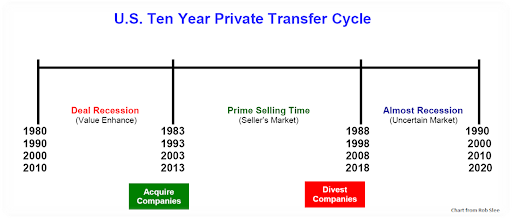
Markets run in cycles and timing is important.  If a business is performing well because there is a favorable economy, all things being equal, this can be an optimal time to consider an exit.  Valuation is high, employees are engaged, and – often times – buyers / investors have a high degree of interest and activity.

As the chart below indicates, the last three (3) decades have followed a similar market cycle and this decade is following suit.  

Chart-Exit Planning

Therefore, if you believe the information above, your ‘big picture’ in terms of market timing indicates that the next few years are ideal in terms of market timing.

Company Preparedness

The 2nd ‘big picture’ concept for an exit is Company preparedness.  In other words, your business needs to be [at least somewhat] transferrable to have a successful exit.

There are a large number of items that can lead to poor timing for an exit and lack of company preparedness.  For example, you may have recently had a departure of a key manager, or you may have lost a key customer and need time to replace that revenue.  Alternatively, your CFO or controller may not have your finances in order, or you may have a lawsuit pending that should really be resolved before moving ahead with a transfer of the business.

While timing can rarely ever be perfect, it is important to think through the current and forecasted profitability and valuation to see that your company’s preparedness is optimal for a successful transaction that will result in a valuation and deal structure that works for you personally.

Personal Timing

The final ‘big picture’ concept – and the third consideration in the timing slots of an exit – is personal readiness.  In fact, it probably makes sense to begin the ‘big picture’ thinking of an exit with personal planning.  The reason is that this can be the most complex and take the most amount of time to navigate.  Also, how an owner thinks about an exit is what is most likely to drive the exit process.  In other words, the market and company can be perfectly positioned for an exit, but if the owner does not want to leave, it is possible that an exit process will not begin.

A Vision for a Personal Future Without the Company

Prior to considering any of the various options for exiting your business, you must be able to recognize two key elements within yourself:

  •   Realization of where you are right now, and
  •   A clear vision of where you want to be after the exit.

As a successful business owner, you realize that you have created self-worth and profit for both the company and those around you, including your family members.  In building a company, you have built a personal identity, perhaps the only one which is recognized by some family, friends, and business associates. Many owners, without properly considering their new, post-exit identities will be unable to successfully pursue a business exit because of their continued attachment to the business.  In order to ensure a smooth transition, you want to be able to articulate both where you are in your business today and the personal challenges associated with getting you to where you want to be.

Developing Exit Skills

The key to achieving the vision – or the ‘big picture’ – for your exit is an understanding that the tools and skills which have enabled you to build your business will likely be of limited value in planning your exit from the business; you’ll need to learn new skills.  If you are using the same tools, skills, and thoughts that you used to run and grow your business, it is very difficult to move on to the next phase.  The primary reason why this is true is that the development of business value is not entirely consistent with the development of fulfilling personal needs and values. A ‘big picture’ look at your situation will have you begin to ask questions about ‘why’ it is important to design an exit plan that meets the needs that you have defined. 

Concluding Thoughts

Seeing the “big picture” in your exit involves taking the time to reflect on goals of the business, the timing of the market, but most importantly, your interests and objectives outside of the business.  Exploring your personal goals allows you to confidently move forward to the next phase of life, which may or may not include continued involvement with the company.  As in so many aspects of one’s life, perspective is key to ultimate success.  By viewing your exit as an opportunity to a begin a new lifestyle instead of as a loss of your business identity, you can begin developing a ‘big picture’ for your exit.

Business Growth

How to Make Business Growth Predictable

Does this sound familiar? You want to grow your company, but you’ve hit a wall. Or maybe you are trying to make your company easier to run but don’t know how. If this sounds familiar, you are not alone… 81% of all business owners feel this way.

We reviewed a recent survey on the growth of privately held businesses in upstate New York with revenues between $5 million and $250 million. Overall, in 2020, these companies saw an average decrease in sales of 4.7%.  Some of those companies lost 50% or more of their revenue, while others saw an increase in sales of over 30%.

There is no doubt that the pandemic was a primary culprit for the companies surveyed who lost sales in 2020, but even in the prior years the growth rates were all over the board, ranging from growth of 200% to losses in revenue of 9%.  And those numbers only come from companies that reported their results…predictable revenue growth is hard to achieve.

Besides outside economic factors, like the pandemic, there are other reasons that revenue growth is so unpredictable and difficult to sustain.  So, what can we as business owners do to beat the odds and achieve predictable and sustainable growth?

The keys to predictable and sustainable growth are more than simply having an awesome sales team.  It is much more holistic than that.  All aspects of a company must be functioning with the best practices in order to attract and retain quality customers and employees. If your operations, accounting, management, or marketing are not operating properly – it will have a ripple effect on your entire business and its ability to create predictable and sustainable growth. Continually creating and successfully executing a strategic growth plan is the answer.

Assessment

It starts with an assessment of the entire organization both inside and out, with an evaluation of the competition and how the company ranks within the environment in which it operates.  There are a variety of processes and techniques that can be utilized – ranging from a SWOT analysis and  Michael Porter’s Five Forces, Blue Ocean’s Four Actions Framework or tools from the Entrepreneurs Operating System. At FAZ we utilize components of each of these but start by looking at what we call the 18 Value Drivers.

The 18 Value Drivers methodology was developed at MIT and utilizes data collected on over 25,000 middle market businesses. The 18 Value Drivers process is a way to look holistically at every corner of a business and compares the data gathered against the best practices utilized in other companies.  The process looks at everything from branding and marketing to legal and finances to human resources and operations and beyond.

Destination

Before you move forward, you must ask does your company have a Mission and Vision and has it stated its Core Values?  These are critical to defining your company’s destination.  Where are you going?  What do you want to accomplish?

Prioritization

The assessments told us where the company is today, and the Vision provided us with clarity about where we want to go.  Now it is time to develop strategies (routes) to get the company from A to B.    Most companies develop more strategies than can be executed at one time.  There just is not enough time, people or money.  It is time to prioritize.  What needs to be worked on first?  Things to consider when it comes to prioritization include:

  • Do we need to fix something that is putting the company at risk?
  • Is one of the strategies going to give us more immediate results?
  • Can one strategy make a larger positive impact than another?
  • Are there things that must be completed prior to embarking on another strategy?
  • Do we have the skills, money and time to do some of these?
Building Details

To answer some of these questions it may require the management team to begin building details into the strategic plan.  In fact, building the details is the next step and you may find that as you build out the details that the strategy may not be feasible at this time or you may stumble upon a better strategic approach.  The details of the strategies must be framed like any SMART goal.  They must be specific, measurable, achievable, realistic, and time bound.  You must be able to answer what, why, who, how, and when?

Execution

The last step is the most critical.  It is the execution.  The execution phase includes: working the plan, monitoring what is happening, and modifying the plan as needed.  The execution has to be a focal point of the organization’s daily life.  It can’t be something that it is picked up at the end of the quarter and dusted off.

This process is a never-ending process.  On a regular recurring basis, a company must start over and do a new assessment.  It is a company’s commitment to this never-ending process which will build a stronger, more valuable business with predictable and sustainable growth.

Read Our Reviews

FAZ Forensics is rated 4.95 out of 5.0 stars based on 21 review(s).

---

FAZ Forensics did a full review and evaluation of my business and I was very happy with the level of detail and expertise.

- Chris Schmidt

---

Christian has, along with his good nature and thoughtful regard, been exceedingly helpful with sorting out the complexities of our case. We could not be more pleased with our exchange. Thomas and Hema Easley

- Thomas Easley

---

Christian was patient and easy to understand. clear, concise and thorough. he spoke “plain” English and was respectful. he did not “rush” and he responded to every question i had, in a timely manner. no matter how “dumb” it may have seemed. for example, i received some paperwork by mail and i did not understand it. i emailed him about it and he cleared it up that day. thats great customer service!

- Joong Park

---

Really good, very knowledgeable and communicated with us every step of the way.

- Haartz Corporation/Tom Daigneault

---

FAZ has a great team doing terrific work for our clients.

- Jim Towne

---

Exceptional work produced.

- Matt Smith

---

Thanks!

- Arrow Bank

---

FAZ was very professional, knowledgeable and very fair priced. The work performed was prompt, accurate and reliable. I would absolutely hire them again if in need for additional accounting work.

- Arrow Financial Corporation

---

Excellent to work with. Professional and personable.

- Cambridge Central School District

---

Awesome team! They were a pleasure to work with. I would definitely recommend.

- Cambridge Central School District

---

FAZ was extremely thorough and professional in doing our business valuation. We are very pleased with the results

- Anne Choppy

---

Steve and GeNet were great at the valuation we needed. Very satisfied. Thanks,Vince and Anne

- Vincent M. Choppy

---

Perfect

- Zalazar anelardo

---

Gen'et and Paul were extremely responsive to our needs. They listened and responded to any concerns that we had. I would highly recommend them for any forensic engagement needs.

- Jennifer Mulligan

---

Thank-you for asking. Our experience was excellent. The people at FAZ showed a depth of knowledge and experience that was very helpful with the undertaking before us. Well done.

- Guy Tombs

---

The CPAs and staff at FAZ are truly amazing. They explain their process very well and always answered my questions right away. I highly recommend them for all your forensic accounting and evaluation services.

- Ashley Hart

---

Excellent and responsible.

- Peter Lee

---

Steve Ferraro did an excellent job and worked tirelessly as our expert forensic accountant witness. Based on Steve's hard work, the jury awarded every penny that Steve showed our client to be entitled to and completely rejected the conclusions of the opposing side's expert.

- Dave Paliotti

---

Great firm!

- John Harwick

---

The people at FAZ are amazing. They are true professionals. The staff is knowledgeable & kind. You feel like you matter. Anytime I have questions they take the time to go through everything in detail so I completely understand everything. I would definitely recommend FAZ.

- Dan Dagostino