Asset Division in Divorce

There are many factors that go into the asset division among couples during the divorce process. The process is predicated by state law. To determine the division of property, the courts look to the factors enumerated in DRL 236B.  In New York and Massachusetts asset division is defined as equitable distribution.

Equitable distribution means the courts will attempt to make sure the assets are divided in a fair way under the circumstances. This does not always mean a 50/50 split. Even in a 50/50 split you need to know the tax consequences of each asset being divided. This means you also need to know the tax basis of your assets. Otherwise, a 50/50 split may not mean a true 50/50 split.

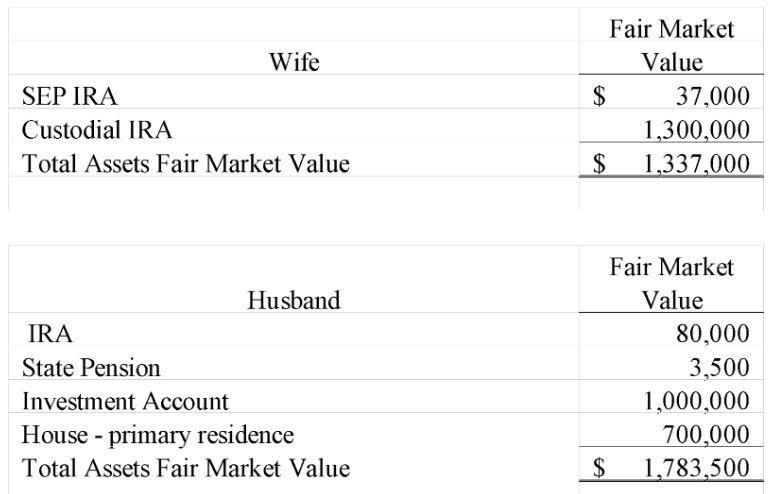
For example, assuming husband and wife have the following assets each will keep post-divorce.

If the assets were to be split equally, the husband would have assets more than $446, 500 and would owe the wife an equalization payment of $223,250 shown as follows:

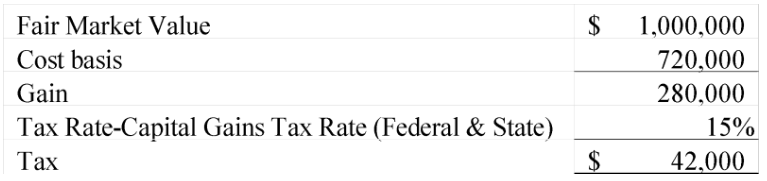
However, certain assets may have different tax consequences that need to be taken into consideration. The house is the couple’s primary residence, and they qualify for a capital gains tax exclusion since they have lived there for two of the past five years. The investment account has a tax basis of $720,000 resulting in a capital gains tax of $42,000 at capital gains tax rate of 15% (both federal and state). 

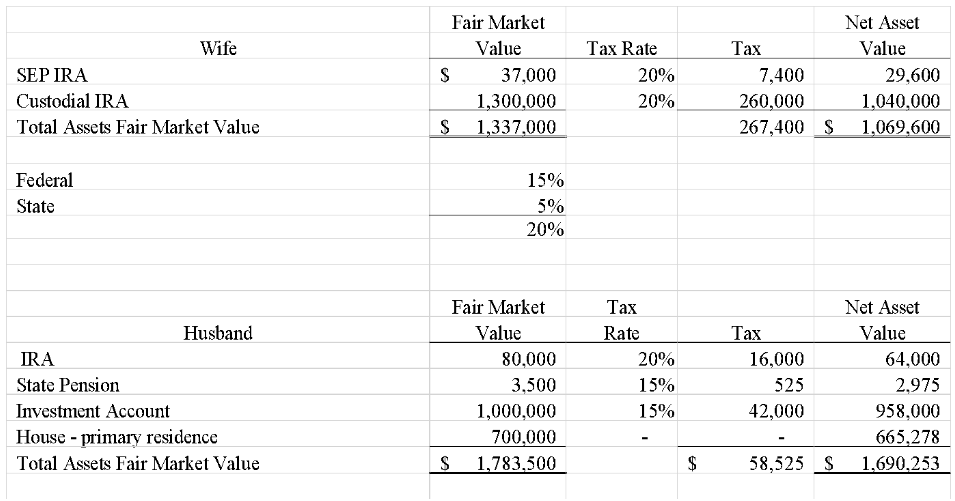
All the other assets would be taxed at their individual tax rates based on income of 20%, except for the state pension, which is not taxable at the state level.

Now when we look at the net asset value after consideration of tax consequences the asset division looks much different.

Taking tax considerations into account becomes essential to equalize the asset division, leading to adjustments in the equalization payment.  By factoring in the tax implications of each asset, the process ensures a more balanced and fair division of assets between the parties involved.

It is important to understand that asset divisions are done on an after-tax basis and therefore not all assets are created equal unless the tax consequences are taken into consideration. A 50/50 split may not be a true 50/50 split without the help of a Certified Public Accountant trained in divorce financial planning.

The ABC’s of ADR’s


The end of a marriage is much more than just a legal event; it also encompasses financial and emotional changes that have consequences for the entire family. It doesn’t have to result in a costly “he said, she said battle” with complex legal issues not understood by the common folk. Finding an alternate method can set the stage for successful co-parenting relationships and mutually satisfactory agreements. Today, more than ever before, disputing parties are opting to settle their differences through alternative dispute resolution (“ADR”) proceedings. ADR is a compelling alternative to settling disputes without litigation. As the structure of ADR evolves, so does the role of the financial expert. It’s optimal for the seasoned professional to be involved from the onset of a dispute to shorten resolution time and cost.

The three most widely used ADR methods are:

Arbitration

The chosen arbitrator is generally someone both sides’ lawyers deem to be an expert. The arbitrator will listen to testimony given under oath and review all documents submitted. It’s often considered an informal trial as the arbitrator can issue binding decisions. These decisions are then made into a court order. The process can be flexible and suited to the party’s needs.

Collaborative Divorce

A scenario where financial experts, lawyers, mental health practitioners, and others come together to create a unified solution. The parties and their attorneys sign a participation agreement, setting a framework for the process and agreeing to settle without going to court. In the event the case goes to litigation, the attorneys must resign. The goal is to settle every issue, share relevant information, and negotiate together.

Mediation

Both sides hire a mutually agreed-upon neutral third party. This person cannot make decisions or give either side legal advice. Their role is to facilitate communications until a compromise is reached. They provide facts to help the parties gather all relevant information to make informed decisions and settle jointly. The mediator has no authority to exact a settlement.


Whichever method you use, it can be crucial to have a financial expert with you every step of the way. It’s their job to discern the numbers and present their findings in a clear, concise, and understandable manner. They can investigate any financial discrepancies between the parties. With a strong understanding of all the numbers, the marital assets, and balance sheets can be updated throughout the process. They can also provide tax advice and help avoid certain complications that may arise. This is even more important after the 2018 Tax Cuts and Jobs Act, which cuts individual income tax rates, doubles the standard deduction, and eliminates personal exemptions. It’s better to know an acceptable range of possible outcomes before going in. The right professional can also value the family business, provide income analysis, calculate child support and alimony payments, as well as trace assets.

We have a staff of experts with a variety of credentials in fields such as business valuation, accounting, and financial analysis. We’ve acted as both a defendant and plaintiff expert, as well as a neutral party. Let us alleviate one less concern.

Business Valuation in Divorce

The divorce process can be stressful and emotional, particularly when dealing with financial decisions involving a family-owned business. A family business can either hold significant value as the largest family asset or simply function as a source of income, providing the owner with a job.


When a business is part of a divorce context, the parties should consider the following:

Choose the Right Types of Valuation:

Calculation of Value

A calculation engagement involves fewer procedures than a valuation engagement, resulting in a calculated value that is usually less costly. According to SSVS No. 1, a calculation engagement occurs when the valuation analyst and the client agree on the valuation approaches, methods, and the extent of procedures. The calculated value, expressed as a single amount or a range, has limited scope and is not suitable for divorce contexts. Typically used in the preliminary stages of divorce valuation, it may help control costs and initiate negotiations. However, it should not be used in the litigation process except for negotiations. Calculations of value may have a specific amount or a range of values, with reporting mechanisms usually being a one-page letter report or an oral report.

Conclusion of Value

Certified Public Accountants must adhere to definitions outlined by the Statement on Standards for Valuation Services (“SSVS”) No. 1 issued by the American Institute of Certified Public Accountants (“AICPA”). SSVS No. 1, issued in June 2007 by AICPA, specifies that a valuation engagement, involving more procedures than a calculation engagement, results in a conclusion of value and is generally more expensive. The engagement occurs when the valuation analyst estimates the value of the subject interest, applying valuation approaches and methods deemed circumstantially appropriate. Conclusions of value have no scope limitation, and reporting options, such as oral reports, letter reports, summary reports, or detailed reports, can help contain the cost of the valuation engagement. In the context of divorce, lower levels of reporting may not meet the objective of communicating the valuation conclusion to the end user and/or reader. It is advisable to start at a lower level but be prepared to move up to the next reporting level if the litigation progresses.


Choose the Right Qualified Appraiser:

During the divorce process, ensure the retention of the right qualified appraiser(s). Many Certified Public Accountants (CPAs) have performed valuations on a part-time basis over the years, but given the consistent changes in the valuation field, finding an appraiser committed to the industry and holding credentials such as Accredited Senior Appraiser (ASA), Accredited in Business Valuation (ABV), Certified Valuation Analyst (CVA), or Certified Business Appraiser (CBA) is crucial.


Hire Only One Appraiser:

This is not the norm, but certainly not out of the ordinary either. There are two reasons why hiring one independent appraiser makes sense. The first reason is that valuation engagements performed by a qualified, respected appraiser can be costly. Good appraisers do not cut corners. They explore every avenue and every aspect considered in a conclusion of value engagement. This takes time and money, but the end result is a valuation that can stand up to any and all scrutiny. The cost of divorce is also expensive, and wherever money can be saved, it should be done. There are some appraisers who will perform the valuation on the cheap, but these are also the ones that are not as thorough. You get what you pay for. The second reason is independence.

The American Institute of Certified Public Accountants (AICPA) Code of Professional Conduct, Rule 102 – Integrity and Objectivity states:

“In the performance of any professional service, a member shall maintain objectivity and integrity, shall be free of conflicts of interest, and shall not knowingly misrepresent facts or subordinate his or her judgment to others.”

The AICPA Statement on Standards for Valuation Services No. 1 states:

“The principle of objectivity imposes the obligation to be impartial, intellectually honest, disinterested, and free from conflicts of interest. If necessary, where a potential conflict of interest may exist, a valuation analyst should make the disclosures and obtain consent as required under Interpretation No. 102-2.”

The hard part for valuation analysts is they are usually hired by one side or the other. It is challenging for most analysts to remain independent and not be advocates for their clients. Some of the best appraisers do not understand this. They will issue an opinion that is as high or as low as they can defend. This is not the way it is supposed to be. To solve that problem, only hire one. There will be no obligation, whether subliminal or not. The single appraiser now becomes a consultant explaining the appraisals and what part of the appraisal is subjective and where there could be ranges of value. This consultant role could not happen with an adversary on the other side.


Making the wrong choices and decisions in a divorce can be costly — and slow down the process. Couples need honest, efficient, and well thought out advice to keep the process moving and make them feel as comfortable as possible as they move onto the next phase of theirlives.

Splitting the Virtual Wallet: Cryptocurrency and High Net Worth New York & Massachusetts Divorces

In many divorce cases, one of the biggest points of contention is the division of marital property and financial assets.  When a divorce involves cryptocurrency assets, or if there are suspicions regarding their ownership, it becomes crucial to address the following question: How can you successfully identify, evaluate, and equitably distribute cryptocurrency holdings?

While property and asset division is a typical aspect of divorce, the complexity of dividing cryptocurrency investments when shared by spouses adds an additional layer of difficulty. Digital currencies are difficult to trace, making them an easy oversight in legal battles such as divorce. Spouses underreport their holdings or try to hide funds in online wallets that can be difficult to get into. For those with malicious intent seeking to hide assets, cryptocurrency emerges as an enticing choice due to its inherent intricacies. 

Cryptocurrency is a digital currency that functions as a medium of exchange.  It uses cryptography to secure and verify transactions as well as to control the creation of new units, of a particular cryptocurrency.  It is a solely digital asset that cannot be counterfeited due to high levels of encryption. It is also decentralized, which means there are no banks involved. Cryptocurrency can exist independently of governments and other authorities.  It’s important to emphasize that concealing assets, including cryptocurrency, is illegal, but many people try it anyway. While full disclosure of assets is required in a divorce, many take the risk and fail to disclose crypto. 

In New York and Massachusetts asset division is defined as equitable distribution. Equitable does not mean equal, and courts are tasked with dividing property in a way that is fair to the parties. Like any other financial asset, cryptocurrency can be considered separate property or marital property depending on when it was acquired and whether it is subject to a valid prenuptial or postnuptial agreement signed by both parties.

In order to determine the division of property, the courts look to the factors enumerated in DRL 236B, which include:

  • Marriage length, age & health of each partner;
  • Property & income held by each spouse;
  • Loss of inheritance or property rights from divorce;
  • Loss of health insurance benefits;
  • Court-ordered maintenance (alimony or child support);
  • Contributions made by each spouse to the other’s separate property;
  • Value or liquidity of all marital property;
  • Future financial circumstances;
  • Assignment of business interests or ownership;
  • Tax consequences of property assignation;
  • Wasted or expended marital property by either spouse;
  • Market value of the marital property at the time of disposition; and
  • Custody of minors and the need to use the marital house and its contents.

Cryptocurrency that qualifies as marital property is subject to the equitable distribution laws and is divisible alongside other marital assets such as savings accounts, checking accounts, investment accounts, real estate, art and more.

 Popular digital crypto assets include the following:

  • Bitcoin (BTC)
  • Ethereum (ETH)
  • Bitcoin Cash (BCH)
  • EOS (EOS)
  • Binance Coin (BNB)
  • Stellar (XLM)
  • Litecoin (LTC)
  • Ripple (XRP)
  • Cardano (ADA)
  • Tether (USDT)

The digital assets are not untraceable. Transactions are recorded on public ledgers called blockchains, which allow Forensic Accountants to follow the money. Some popular forensic tools for blockchain analysis are: Chainalysis Reactor, CipherTrace, and Elliptic. Cryptocurrency owners have the option to store their digital assets in either “hot” or “cold” wallets, or a combination of both. A “hot” wallet remains connected to the internet, providing convenient access for owners to manage and spend their crypto holdings as needed. These wallets are comparatively more accessible and easier to locate.

On the other hand, “cold” wallets involve transferring cryptocurrency to wallets where the private keys, which act as the essential passwords for moving crypto out of the wallet, are stored on devices not connected to the internet. Identifying the presence or assessing the value of assets within a cold wallet presents a significantly greater challenge. This lack of transparency could potentially be exploited to conceal assets during divorce proceedings.

Valuing assets in divorce litigation is not always cut and dry especially when it comes to cryptocurrency. Cryptocurrencies are highly volatile and can experience significant price fluctuations quickly. Determining an accurate and fair valuation is essential to ensure an equitable distribution of marital property. To solve that problem, divorcing spouses can agree that the value of a cryptocurrency will be its value at the time of distribution. 

Cryptocurrency transactions are subject to capital gains tax. This means that if you sell or exchange cryptocurrencies for a profit, you may be required to report and pay tax on the capital gain. The tax rate may vary depending on how long you held the cryptocurrency (short-term vs. long-term) and your overall income level. Transferring cryptocurrencies as gifts or as part of an inheritance may also have tax consequences. In some cases, the recipient may need to pay gift or inheritance tax based on the cryptocurrency’s fair market value at the time of transfer.  It is imperative for the involved parties to carefully evaluate the tax implications to ensure equitable asset division. Given that not all assets are equally subject to taxation, it is crucial to ensure a fair comparison and division of assets.

Some documents that matrimonial attorneys should include in their discovery demands and subpoena are listed below:

Discovery Requests for Cryptocurrency

  • Bank/Credit Card Statements;
  • Tax Returns;
  • Forms 1099-K issued by cryptocurrency exchanges;
  • Email correspondence, chat logs, or messages discussing cryptocurrency transactions or related matters. Social media records that may contain relevant information;
  • A list of digital assets held, received, accepted, used, purchased or sold as of a certain date;
  • All Master Public Key(s) and/ or Extended Master Public Key(s) (a/k/a Xpub, Ypub, Zpub) for any cryptocurrency wallet(s) owned, and
  • Computer hardware and software devices used (or previously used) in connection with digital assets.

While dividing crypto assets can present unique challenges due to their volatility and complex nature, an experienced Forensic Accountant can help ensure that you receive a fair share of these digital assets. The experts at FAZ understand the intricacies of divorce cases involving hidden assets, including cryptocurrencies. We assist attorneys not only identify assets and liabilities but provide a roadmap for the valuation.  We provide facts supporting the classification for marital, non-marital, or separate assets, and assist the Court to an ultimate appropriate resolution.

New Claim Referral

At FAZ Forensics, we handle property and casualty claims resulting from fires, auto accidents, water damage, mechanical breakdown, power outages, fraud, terrorist attacks, employee theft, natural disaster and more.

If you would like to refer a Business Interruption, NYS No-Fault, or other Insurance claim, download the Claim Referral Form and submit to FAZ via email, eFax, regular mail, or upload to Dropbox.

[minti_button link=”https://fazforensics.com/wp-content/uploads/2022/07/Claim-Referral-Form-December2022.pdf” size=”medium” target=”_blank” lightbox=”false” color=”color-2″ icon=””]CLAIM REFERRAL FORM[/minti_button] [minti_button link=”https://www.dropbox.com/sh/pbc76y1fqorf6yk/AADyOp26Cwh6nzU11_mc-EfNa?dl=0″ size=”medium” target=”_blank” lightbox=”false” color=”color-1″ icon=””]UPLOAD NEW CLAIM[/minti_button]


Internal Controls for Businesses

Female executive showing data to team in meeting

It is too often that we see news of embezzling funds within an organization. As forensic accountants at FAZ Forensics, we have investigated these matters in Albany, Saratoga, New York City, Boston, and all over the country. A common theme within these matters is limited internal controls within the organization. 

According to the Association of Certified Fraud Examiners 2022 Report to The Nations on Occupational Fraud, it is estimated that organizations will lose 5% of revenue each year to fraud. Nearly half of the cases of fraud occurred due to lack of internal controls or an override of existing controls. 

No matter the size of your company, take steps like the following to prevent embezzlement:

Segregate Financial Duties in your Organization

Where possible, functions such as bookkeeping, deposits, and reporting should be done by different employees. This can be critical if your organization has had layoffs or departures within the finance department as adequate staff to segregate is not possible. The ACFE report states that organizations with the fewest employees had the highest median loss on average of $150,000. 

Set up Positive Pay or Reverse Positive Pay with your Financial Institution

With positive pay you send a list of checks to the bank that you approved. With reverse positive pay, the bank sends a list of all checks presented for payment. This will avoid someone including checks not approved.

Dual Signatures/Dual Authorization on Checks and Outgoing Wires for amounts over a Certain Threshold

The basic idea here is no one person, including one of the owners, CFO or other individuals, can single-handedly disburse substantial amounts.

Thoroughly Review Bank Statements and Corporate Credit Card Statements

The best way to start uncovering fraud is to review the bank and credit card statements. If anything looks suspicious, be sure to inquire about it. Review the statements regularly.

Cash Flow Projections and Budgets

A cash flow projection and budget are models against which you can compare your actual results. Review often, look for significant variances, investigate and find the cause. Aside from fraud, you can identify other problems in your business that need to be addressed.

Background Checks for Employees

It starts with the hiring process. Know how to interview and how to follow-up on their references. Especially those who will have access to or influence your business finances. 

Management and Tone at the Top

Management needs to take an active role in preventing an embezzlement and ensure internal controls are adequate. The ACFE report states that lack of management review and a poor tone at the top contribute to embezzlements within an organization. 

Hire a Consultant to Do a Periodic Review

It is always a good practice to have an independent review of your internal controls. The money spent on the consultant would be well worth it.

Another key point is to always be on the lookout for behavioral red flags that could provide insight to a potential fraud. 

The ACFE report indicates in their study that only 6% of employees committing fraud had a prior fraud conviction and that a red flag was identified in 76% of the cases studied, so be on the lookout for some of these red flags which include:

  • Employees that are living beyond their means.
  • Employees having financial difficulties.
  • Employees that have divorce/family problems.
  • Employees that complain about inadequate pay.
  • Employees that have addiction problems such as gambling, drugs, etc. 
  • Employees that have an unwillingness to share duties.

Remember, a typical fraud can last 14 months before being detected. If controls are not adequate, it could last for years and be the demise of an organization. Keep in mind that employees can only steal when they are not closely watched. Employees that are closely watched have a challenging time stealing. With that said, it is vital that you review the internal controls periodically within your organization.

Commercial Damages - Insurance and Finance

Selecting a Financial Expert: Commercial Damages

Whether working for the Plaintiff or the Defendant, selecting a forensic CPA and commercial damages expert is typically a very important decision all attorneys need to make in a complex commercial litigation matter. In most cases the jury, and even the trier of fact, will not be very well versed in the financial issues. Consequently, the damages expert needs to be a person who can explain complex accounting and financial concepts in a clear, concise and easy to understand manner. A capable expert will be able to explain how these concepts relate to the economic damage model and supporting calculations. As many attorneys recognize, finding a suitable expert can be a challenging process.

Several factors must be taken into consideration before selecting the right expert, particularly if the prospects for deposition and/or trial testimony are significant. Engaging an experienced and knowledgeable expert who has previously testified in a deposition and/or trial can be very valuable for the attorney and their client. The following are some specific factors that should be considered when selecting a commercial damages expert:

Relevant and Current Training: The expert should have formal forensic training specific to the calculation and presentation of commercial damage analyses in a litigation or similar contentious environment. Many organizations which grant supporting forensic credentials (discussed below) require that minimum continuing educational requirements be met to maintain their designations. A typical requirement is 120 hours over a three-year period…or. on average, 40 hours per year.

Related Forensic Experience: Attorneys should evaluate the commercial damage expert’s amount of relevant experience. Look for a damage expert who has worked on comparable cases. While lack of prior industry experience in most cases is not a deal breaker, it might be preferred in certain instances. 

Previous Testimony Experience: Attorneys should investigate previous cases to see the opinions and reports the damage expert has issued in the past for deposition or trial. Counsel should also find out whether an expert has been subject to Daubert challenges and/or has had their opinion excluded at trial. This is a critical part of the selection process.

Supporting Credentials: The damage expert’s credentials are an important part of the decision-making process. The attorney should look for a damage expert with relevant credentials governed by the American institute of Public Accountants (AICPA), the National Association of Certified Valuation Analysts (NACVA) and other relevant organizations.  Some of the more pertinent credentials are the following: Certified Public Accountant (CPA), Master Analyst in Financial Forensics (MAFF), Certified Business Appraiser (CBA). Chartered Financial Analyst (CFA), Accredited in Business Valuation (ABV), Certified in Financial Forensics (CFF) and Certified Valuation Analyst (CVA). The damage expert should also be an active participant in the organizations that monitor their relevant designations.

Communication Skills: It’s important that the attorney evaluate the damage expert’s communication skills. The attorney should consider how the expert will communicate their findings during testimony and determine if that communication style will be effective.

Positive References: Attorneys should also ask for prior case references from the expert and contact their colleagues to see if they have any prior experience or knowledge in working with or against the damage expert. There are many instances in which attorneys’ partners or colleagues have prior dealings with a damage expert and can give good insight into whether he or she will be a fit for a case.

Once the attorney has selected a commercial damages expert it’s important for them to keep the following in mind when working with the expert and preparing for your case:

Scope and Timing of Work: The damage expert should understand the scheduling order and work to develop the expert report and prepare for potential deposition and trial testimony. The attorney should understand the time it will take for the expert to prepare the report based on the scope of the assignment.

Damage Theory: Explore and debate various damage theories with the damage expert and decide together which damage theory best matches the facts of the case.

Document Requests: Whenever possible, the damage expert should make a formal document request well before discovery closes. This should allow for an initial review of preliminary documents and a follow up document request, if necessary.  It’s imperative to provide the expert with all the necessary documentation for their analysis to enable them to prepare a sound expert opinion or rebuttal report.

The Expert Report: Discuss the requirements of the expert opinion or rebuttal report and the level of detail that needs to be included.

Preparation for Deposition and Direct & Cross-Examination: Work with the damage expert to prepare them for direct and cross-examination. Prior to deposition and trial, the attorney and damage expert should evaluate the opinions issued and information used in the expert report to anticipate the questions that might be asked in deposition and cross-examination. It is critical for the attorney to communicate questions or topics which may be asked by opposing counsel so the damage expert can be adequately prepared.

Attorneys who understand the process for selecting and working with a commercial damage expert can improve their chances of successful outcomes. Once engaged, the expert and counsel should work together to make sure that they both understand the scope of the assignment for both report as well as deposition and trial preparation.

Wrongful Death

FAZ Personal Injury & Wrongful Death Services

At FAZ, we work with Plaintiff attorneys in the resolution of personal injury and wrongful death claims, and have performed hundreds of lost earnings evaluations. We prepare computational exhibits and reports that are suitable for settlement and/or trial and provide courtroom testimony when the need arises. In addition to lost earnings, we have experience and expertise in the following areas:

  • Future Earnings Capacity
  • Lost Self-Employment Earnings
  • Fringe Benefits
  • Pension Benefits Analysis
  • Household Services
  • Life Care Plan Projections

 If you would like to discuss a case or have a question, please feel free to contact FAZ Partner Charles Amodio at camodio@fazforensics.com or call him directly at 518-288-2142.

Download Form Upload Files

Business Interruption Claims

business banner

At FAZ, we specialize in the resolution of Business Interruption claims for lost profits resulting from fires, water damage, mechanical breakdown, power outages, terrorist attacks, natural disaster, and more.  In addition to lost profits, our accounting and insurance experience has allowed us to help successfully settle claims involving the following coverage issues and circumstances:

Inventory Claims

Extra Expense

Loss of Rents

Employee Theft

Personal Injury & Wrongful Death

Coinsurance

Subrogation

Errors & Omissions

Construction Claims

If you would like to refer a claim, download the Claim Referral Form and submit to FAZ via email, eFax, or regular mail.

[minti_button link=”https://fazforensics.com/wp-content/uploads/2020/05/Claim-Referral-Form.pdf” size=”medium” target=”_blank” lightbox=”false” color=”color-2″ icon=””]CLAIM REFERRAL FORM[/minti_button]

When submitting a Business Interruption Referral, in addition to the claim referral form, kindly forward a copy of the insured’s policy, declaration page, contact information, the insured’s calculation of the claim, and supporting financial information, if available.

If you would like to discuss a claim or have a question, please feel free to contact FAZ Partner Charles Amodio at camodio@fazforensics.com or call him directly at 518-288-2142.

No-Fault Lost Earnings Claims

no-fault loss

At FAZ, we specialize in No-Fault Lost Earnings claims resulting from automobile accidents.  More specifically, we have extensive experience analyzing claims for lost self-employment earnings and substitute wages. We’ve developed an efficient and effective process to quantify lost earnings to help you successfully settle the claim.

If you would like to refer a No-Fault Claim, download the Claim Referral Form and submit to FAZ via email, Efax, or regular mail.

Download Referral Form

When submitting a No-Fault Claim, in addition to the claim referral form, kindly forward a copy of the insured’s NYS NF-7, NYS NF-2, the insured’s last two years of income tax returns, attorney contact information, and any other supporting financial information, if available.

If you would like to discuss a claim or have a question, please feel free to contact FAZ Partner Charles Amodio at camodio@fazforensics.com or call him directly at 518-288-2142.

Preventing Small-Business Fraud

Small businesses are more likely to become the victims of fraud than larger businesses.

Small businesses are the most vulnerable to occupational fraud and abuse, according to the Association for Certified Fraud Examiners (ACFE). In its 2020 Report to the Nation on Occupational Fraud and Abuse, ACFE cites that the smallest organizations, 100 employees or less, suffered higher median losses than did the largest organizations (10,000 employees or more). While the largest companies suffered losses of $140,000 on average, small businesses’ losses averaged $150,000, based on its survey.

Considering the potential losses and how much more of an impact $150,000 is to a smaller business than a larger business, it befits small-business owners to make the prevention of fraud a priority. Though no business owner wants to feel it employs unscrupulous people, sometimes temptation or personal financial pressures can push even the hardest working, most trusted employee into perpetrating fraud.

Here’s how you can prevent fraudulent activity in your workplace:

Hire the right employees. Small companies seldom bother doing background checks on new employees, which means they’re potentially inviting hackers, predators and even convicted felons into the organization. While every business strives to hire honest employees, having a formal hiring routine, even at a small business, can help prevent fraud. Don’t rely entirely on references and work history. Conduct background checks for people handling inventory and money. Check past employment, criminal convictions, education and certifications. Conduct drug screening, since employees will often steal from a business to support an addiction. However, remember to always get the written consent of candidates before drug testing, since many federal and state laws govern the gathering of such information. Once the employee is being considered for hire, review their social networks for anything that could be damaging to your business’s reputation, especially any animosity against their former employer.

Maintain strong internal controls. Small businesses need to create and maintain internal controls that can prevent or detect fraud. This includes restricting access to financial account data, inventory access, establishing multi-person sign-off on expense reimbursements, overtime, all check writing functions, other accounting or payroll functions, and performing an overview of audit logs to ensure the integrity of the books.

Safeguard your entry and computer systems. Be sure to limit access to specific areas of the business for certain employees. Additionally, set up strict protocols for creating and updating passwords into computer systems.

Conduct surprise audits regularly. Occasional non-scheduled audits can also help detect fraud. Businesses should routinely audit areas that deal in cash, refunds, product returns, inventory management, and accounting functions. Include surprise audits as part of your pro-active fraud policy. All too many notable fraudsters knew that the auditors were coming, allowing them time to alter, destroy, or misplace evidence of their wrongdoing. Make it a surprise to catch an employee off guard.

Establish an anonymous reporting system. Tips from employees is the number one method for catching fraud. Because most employees are reluctant to report suspicious activity, there needs to be an avenue for them to report fraud anonymously. Establishing an anonymous reporting system or process can also set their mind at ease about letting their bosses know about a fellow coworker.

Require time away. Employees that don’t take vacations should raise a red flag. An employee who comes in early and stays late or never takes a vacation has the perfect opportunity to conceal their wrongdoing. Requiring employees to take time off can aid in the prevention of some frauds.

Train employees to detect and prevent fraud. Employees in fraud-prone areas of the business should know the warning signs of fraud, prevention skills and how to report suspicious behavior or actions by coworkers and customers. Provide periodic training to help employees understand fraud and what to do in the event of fraud.

Implement policies to protect your reputation. Institute an employee policy that outlines expected employee behavior anytime they represent the company, including any mentions on their social networks.

Set the tone at the top and have policies, including a fraud policy. Have a written ethics and fraud policy. Companies frequently have an ethics policy, which sets forth in detail what is expected in the ethical climate of the company. A fraud policy spells out actions that constitute fraud and how those actions will be punished. Simply inform employees during employee orientation, training programs, memorandums, or other communication that fraud is not tolerated and let employees know what to do if they suspect fraud.

Increasing the perception of detection is one of the best fraud deterrents. Make sure employees are aware that dishonest acts will be punished. The opportunity to commit fraud is easier to rationalize when employees believe their wrongful acts will go undetected and unprosecuted. Perception of detection is a very powerful deterrent. Essentially, let it be known to employees that you are watching for it.

Purchase Insurance. While we have discussed many items to help deter fraud, no measure is foolproof. Consider getting an insurance policy that specifically protects against various frauds.

The prevention of fraud starts with a conversation. Encourage leaders and advisors of your business to start these today!


no-fault loss

Valuation Expert Driscoll Joins FAZ

Ferraro, Amodio & Zarecki, CPAs (FAZ) is pleased to announce the addition of Duff W. Driscoll, CPA/ABV as Director in its Business Valuation Group. Driscoll is a Certified Public Accountant with over thirty-five (35) years of public accounting experience, including several years with Big 4 firm, Ernst and Young.

Having specialized in valuation and litigation support services for over twenty-five (25) years, he has participated in more than six hundred (600) litigation cases performing valuations and/or economic damage assessments and ancillary services. Valuation subjects have included closely held businesses, professional practices, licenses and pension plan benefits for use in domestic relations and shareholder dispute cases. His economic damage assessments have been performed in connection with matters that include, but are not limited to, business interruption, breach of contract, fraud, professional malpractice, and personal injury claims.

In addition, he has participated in more than four hundred (400) independent business, professional practice license, and pension benefit valuations for a variety of purposes including litigation, mergers and acquisitions, buy and sell transactions, and estate and gift tax matters.

Driscoll is qualified as a financial expert and has provided in-court testimony in support of his valuation and other economic findings and opinions in New York State Supreme Court in several different counties, U.S. District Court, New York State’s Court of Claims and in New York and Vermont Family Courts.

“I’m excited to have joined FAZ, a leading forensic accounting, valuation and business advisory firm, to help support their growing business valuation, business advisory and forensic accounting efforts”, Driscoll said. “For decades, the FAZ team has served as valued forensic experts and business advisors and has built a strong reputation throughout the Capital Region and the entire Northeast.”

“Duff is a great addition to our team, and he brought a wealth of extremely valuable experience in the areas of business valuation and economic damage assessments to FAZ,” said FAZ partner Stephen Ferraro. “Our valuation work has seen significant growth in recent years and Duff will continue to be a great resource for our clients, as well as our team members in the strategic expansion of our business valuation and related services.”

Read Our Reviews

FAZ Forensics is rated 4.95 out of 5.0 stars based on 21 review(s).

---

FAZ Forensics did a full review and evaluation of my business and I was very happy with the level of detail and expertise.

- Chris Schmidt

---

Christian has, along with his good nature and thoughtful regard, been exceedingly helpful with sorting out the complexities of our case. We could not be more pleased with our exchange. Thomas and Hema Easley

- Thomas Easley

---

Christian was patient and easy to understand. clear, concise and thorough. he spoke “plain” English and was respectful. he did not “rush” and he responded to every question i had, in a timely manner. no matter how “dumb” it may have seemed. for example, i received some paperwork by mail and i did not understand it. i emailed him about it and he cleared it up that day. thats great customer service!

- Joong Park

---

Really good, very knowledgeable and communicated with us every step of the way.

- Haartz Corporation/Tom Daigneault

---

FAZ has a great team doing terrific work for our clients.

- Jim Towne

---

Exceptional work produced.

- Matt Smith

---

Thanks!

- Arrow Bank

---

FAZ was very professional, knowledgeable and very fair priced. The work performed was prompt, accurate and reliable. I would absolutely hire them again if in need for additional accounting work.

- Arrow Financial Corporation

---

Excellent to work with. Professional and personable.

- Cambridge Central School District

---

Awesome team! They were a pleasure to work with. I would definitely recommend.

- Cambridge Central School District

---

FAZ was extremely thorough and professional in doing our business valuation. We are very pleased with the results

- Anne Choppy

---

Steve and GeNet were great at the valuation we needed. Very satisfied. Thanks,Vince and Anne

- Vincent M. Choppy

---

Perfect

- Zalazar anelardo

---

Gen'et and Paul were extremely responsive to our needs. They listened and responded to any concerns that we had. I would highly recommend them for any forensic engagement needs.

- Jennifer Mulligan

---

Thank-you for asking. Our experience was excellent. The people at FAZ showed a depth of knowledge and experience that was very helpful with the undertaking before us. Well done.

- Guy Tombs

---

The CPAs and staff at FAZ are truly amazing. They explain their process very well and always answered my questions right away. I highly recommend them for all your forensic accounting and evaluation services.

- Ashley Hart

---

Excellent and responsible.

- Peter Lee

---

Steve Ferraro did an excellent job and worked tirelessly as our expert forensic accountant witness. Based on Steve's hard work, the jury awarded every penny that Steve showed our client to be entitled to and completely rejected the conclusions of the opposing side's expert.

- Dave Paliotti

---

Great firm!

- John Harwick

---

The people at FAZ are amazing. They are true professionals. The staff is knowledgeable & kind. You feel like you matter. Anytime I have questions they take the time to go through everything in detail so I completely understand everything. I would definitely recommend FAZ.

- Dan Dagostino